












Product Details
Product Overview
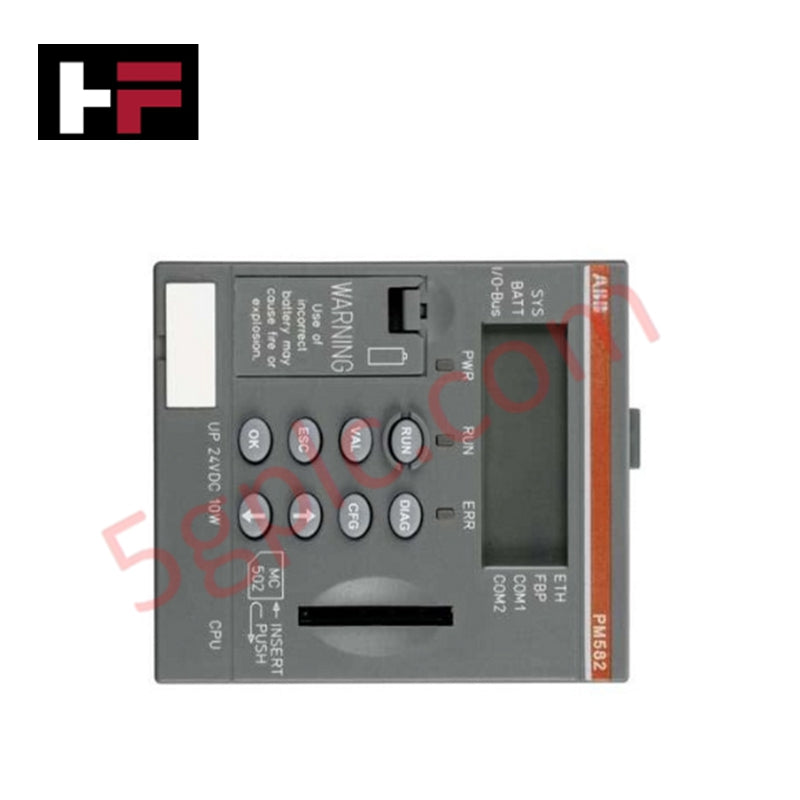
The ABB PM585-ETH (1SAP140500R0271) functions as a premium central processing unit within the modular AC500 PLC platform. Designed for high-performance automation, this CPU delivers an exceptional processing speed of 0.000004 ms per instruction, making it one of the fastest processors in its class. It integrates 1MB of program memory with native Industrial Ethernet, dual serial interfaces, and an FBP port to coordinate complex, data-intensive control architectures. We supply this unit as 100% Brand New and Original, ensuring your critical infrastructure operates with factory-certified precision and peak deterministic performance.
Technical Specifications
The PM585-ETH manages large-scale automation tasks through the following technical parameters:
-
Processor Type: AC500 High-Performance CPU
-
Program Memory: 1 MB
-
Total Storage Capacity: 3584 kB
-
User Data Memory: RAM-based architecture
-
Controller Processing Time: 0.000004 ms (0.004 µs) per instruction
-
Communication Interfaces: 1x Industrial Ethernet (RJ45), 2x RS232/485 (Configurable), 1x FieldBusPlug (FBP)
-
Display: Integrated LCD for local status and diagnostics
-
Rated Voltage: 24 V DC (Range: 20.4 – 28.8 V DC)
-
Protection Rating: IP20
-
Net Dimensions: 67.5 mm (W) x 76 mm (H) x 62 mm (D)
-
Net Weight: 0.137 kg
Engineering Advantages
-
Ultra-Fast Deterministic Control: A processing speed of 0.004 µs per instruction allows the CPU to manage complex motion control and high-speed synchronized processes with virtually zero jitter. This performance stabilizes control loops in high-throughput packaging and precision assembly lines.
-
Integrated Ethernet Backbone: The native Ethernet port supports Modbus TCP and standard TCP/IP protocols. This facilitates direct uplink to SCADA and ERP systems while managing decentralized I/O clusters through a single high-speed connection.
-
Dual-Port Serial Flexibility: Two independent RS232/485 ports enable the CPU to communicate with legacy instruments and serial-based field devices simultaneously. Engineers configure each port individually to optimize data flow between different hardware generations.
-
High-Density Memory Architecture: With 1MB of program memory and over 3.5MB of total storage, this CPU handles extensive data logging, complex user-defined function blocks, and large application projects without requiring external memory hardware.
-
Rapid Field Maintenance: The integrated LCD provides real-time diagnostic codes and system status directly at the mounting rail. This visibility allows maintenance staff to identify hardware faults or communication errors instantly without connecting a laptop.
FAQs
-
Does the PM585-ETH require a specific Terminal Base for mounting? Yes. You must install the PM585-ETH on a compatible ABB AC500 Terminal Base (such as the TB5xx series). The base handles the 24V DC power distribution and provides the physical interface for the DIN rail and expansion modules.
-
How do I configure the RS232/485 ports for different protocols? You perform all port configurations within the ABB Automation Builder software. Each port functions independently, allowing you to run Modbus RTU on one channel while maintaining an ASCII or proprietary serial link on the other.
-
Can the Ethernet port handle web-based visualization? The integrated Ethernet interface supports web server functionality. You can host custom diagnostic pages and process visualizations directly on the CPU, enabling remote monitoring via a standard web browser on a secure network.
-
What is the benefit of the FBP (FieldBusPlug) interface on this model? The FBP interface allows this CPU to integrate into various fieldbus environments like PROFIBUS DP or CANopen simply by using the appropriate external plug. This feature provides a future-proof migration path if your plant networking standards change.
Additional Information
- 100% Genuine Parts: All products are original and authentic, ensuring reliable industrial performance.
- 30-Day Refund Guarantee: Return any in-stock item within 30 days in original, unopened packaging for a full refund (excluding shipping and fees).
- 12-Month Warranty: Covers defects in materials or workmanship; excludes misuse, normal wear, or unauthorized modifications.
- Worldwide Shipping: We ship via USPS, UPS, FedEx, and DHL. Delivery times vary by country and may be subject to customs or import fees.
- Support & Contact: Technical and warranty assistance is available anytime. Contact us here: Contact.
- Purchase Guidance: Check product specifications and compatibility carefully before ordering to ensure proper application.






Tech & Buying Guide

Mastering Wire Identification in Industrial Automation: The Power of Ferrules and Cross-Ferruling
Proper wire labeling forms the cornerstone of reliable control system installation and long-term maintenance. In complex industrial automation environments, technicians terminate thousands of conductor ends inside control panels, marshalling racks, and field junction boxes. Ferrules serve as individual tube-shaped sleeve markers slipped onto conductors before final termination. While technicians historically relied on pre-printed individual letter rings, modern control panel builders utilize automated ferrule printing machines. These thermal-transfer printers generate durable, single-sleeve heat-shrink tags directly matching approved wiring schematics, significantly accelerating cabinet assembly workflows.

Understanding Marshalling Cabinets in Industrial Automation and Control Systems
Marshalling cabinets serve as the crucial connection hub between field instruments and centralized processing units. In large DCS and PLC control system architectures, hundreds of multipair field cables run from local junction boxes to the central instrument equipment room. The marshalling cabinet houses field terminal blocks, surge arresters, intrinsic safety isolation barriers, and interposing relays. By segregating field field-wiring terminations from sensitive processor hardware, engineers protect expensive controller backplanes from high-voltage transients. Consequently, this modular separation dramatically streamlines maintenance workflows and simplifies system expansion.

Essential Best Practices for PLC Wiring and Installation in Industrial Automation
Successful control system deployment begins with thoroughly reviewing manufacturer technical documentation. Controllers from major brands like Allen-Bradley, Siemens, and Schneider Electric feature unique terminal layouts. Engineers must verify voltage requirements before connecting power cables to prevent catastrophic equipment damage. Standard line connections require strict adherence to regional electrical codes and proper wire color coding. Furthermore, panel builders should always establish a robust low-impedance ground connection using at least 16-AWG copper conductor tied directly to the main plant grounding grid.