Achieving Deterministic Industrial Networks Through Time-Sensitive Networking (TSN)
- 〡
- 〡 by WUPAMBO
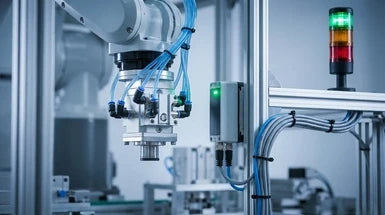
Industrial automation environments increasingly demand high-speed, deterministic data transmission to coordinate complex machinery and factory automation lines. Therefore, control engineers continually seek networking technologies that eliminate unpredictable latency and packet loss. In my 15 years of commissioning distributed control systems (DCS) and high-speed motion networks, I have witnessed how traditional Ethernet bottlenecks can trigger unforced production stops. Below, I explore how Time-Sensitive Networking (TSN) transforms standard Ethernet into a deterministic communication backbone.
The Limitations of Traditional Ethernet in Industrial Automation
Standard Ethernet remains the most popular communication medium across industrial facilities due to its speed and simplicity. However, traditional Ethernet operates on a non-deterministic, first-come, first-served basis. Consequently, data packets often experience unpredictable delays caused by network congestion and traffic loading. In high-speed motion control or safety applications, even a ten-millisecond delay can compromise process integrity. Because standard Ethernet cannot differentiate between critical safety messages and routine supervisory data, advanced industrial networks require a deterministic upgrade.
Understanding Time-Sensitive Networking (TSN) Standards
Time-Sensitive Networking (TSN) represents a suite of IEEE standards designed to deliver deterministic Ethernet communication. By enforcing strict time synchronization across all connected devices, TSN guarantees that critical data packets arrive at their destinations exactly on schedule. Furthermore, TSN utilizes IEEE 802.1AS Precision Time Protocol (PTP) to maintain sub-microsecond clock synchronization across the entire network infrastructure. This unified time reference allows network switches to coordinate transmission windows with absolute mathematical precision.
How Time-Aware Schedulers Prioritize Critical Traffic
TSN eliminates random packet collisions by implementing advanced traffic shaping and scheduling mechanisms. Specifically, TSN switches utilize a Time-Aware Scheduler (TAS) governed by IEEE 802.1Qbv standards. The TAS divides network transmission into repeating time cycles, allocating dedicated time slots exclusively for high-priority industrial control traffic. Consequently, time-critical motion commands or safety interlocks bypass non-critical background data instantly without waiting in congested buffers.
Guaranteeing Reliability Through Stream Reservation and Redundancy
Configuring a deterministic TSN network requires precise resource allocation and fault-tolerant mechanisms. Network engineers utilize the IEEE 802.1Qat/Qcc Stream Reservation Protocol (SRP) to reserve bandwidth and buffer space across every switch along the communication path. In addition, critical control loops deploy IEEE 802.1CB frame replication and elimination for seamless network redundancy. By transmitting duplicate data streams across separate physical paths, the network ensures zero packet loss even if a single cable or switch port fails.
Practical Solution Scenario: Synchronizing Multi-Axis Motion Control
Consider a high-speed packaging plant utilizing multiple servo drives and programmable logic controllers (PLCs) requiring sub-millisecond synchronization. Traditional Ethernet switches introduce unpredictable jitter that causes axis desynchronization and mechanical wear. The automation engineering team upgrades the factory network by deploying TSN-capable managed switches and PTP-enabled drives. The TSN architecture reserves dedicated time slots for cyclic motion data while handling standard SCADA diagnostics in background windows. As a result, the multi-axis system achieves flawless deterministic coordination, eliminating mechanical tracking errors and maximizing overall production throughput.
About the Author
Zhang Wei is a Senior Industrial Automation Expert with over 15 years of international field experience specializing in industrial Ethernet networking, TSN implementation, motion control, and PLC programming. Throughout his professional career, Zhang has successfully designed and commissioned high-speed automation networks for numerous smart manufacturing plants, packaging lines, and automotive assembly facilities across Asia and Europe. He is a certified industrial networking specialist who frequently contributes technical documentation to global automation media.
- Posted in:
- control systems
- deterministic networking
- factory automation
- motion control
- PTP
- Time-Sensitive Networking
- TSN