










Product Details
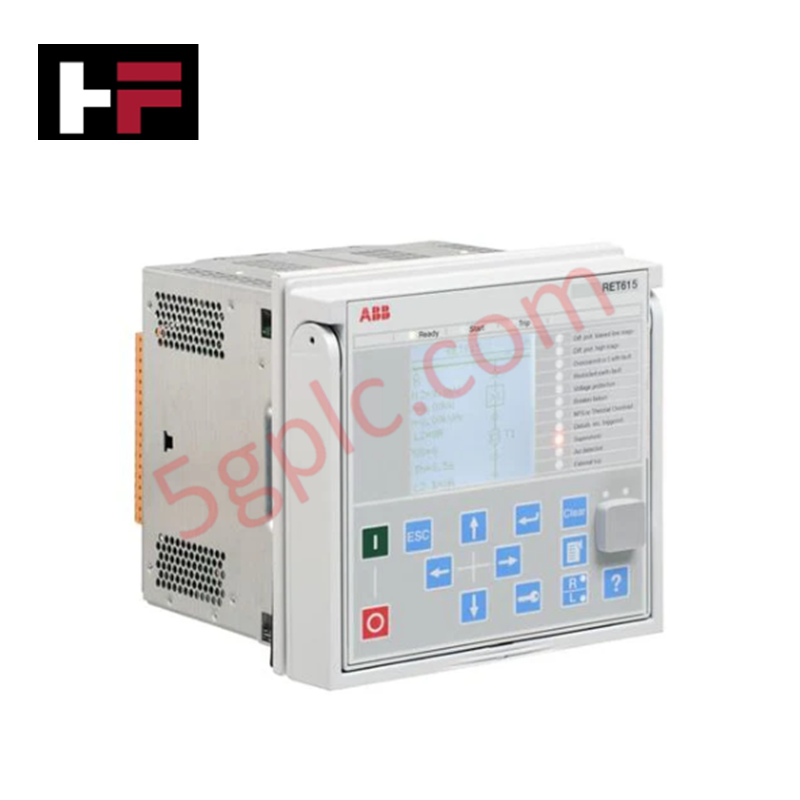
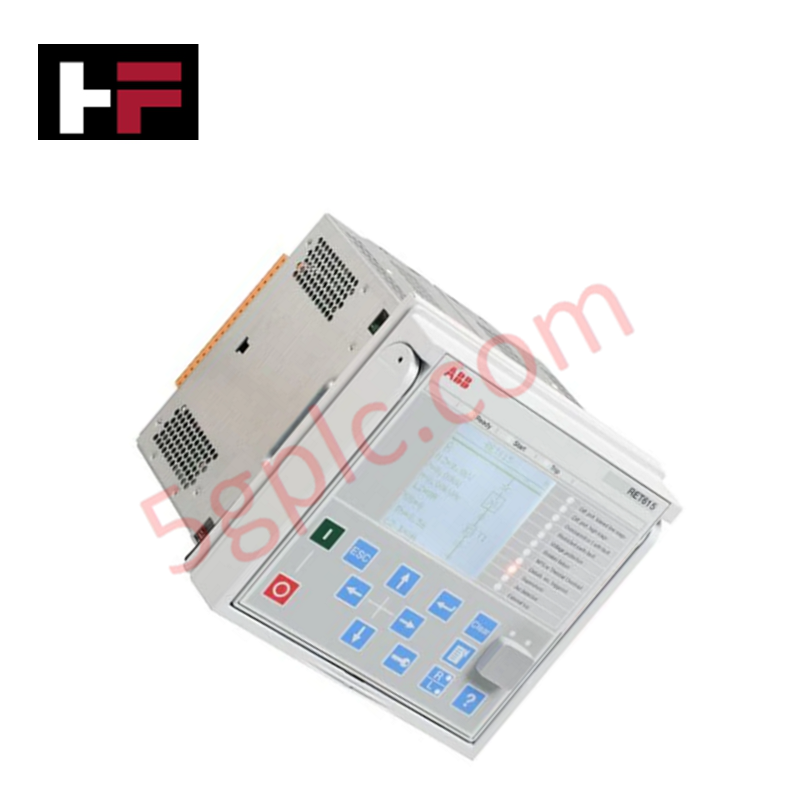
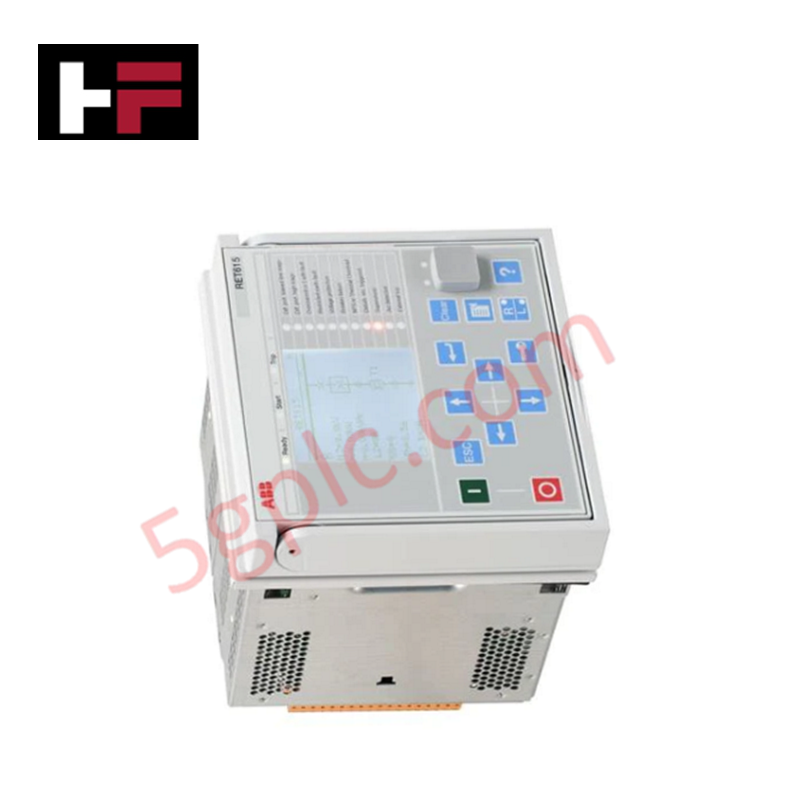
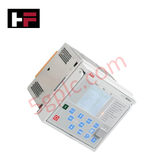
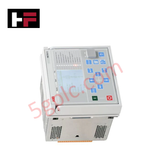
The ABB RET615, also cataloged as the RET615 Transformer Protection and Control Relay, operates as a dedicated hardware component for two-winding power transformer differential processing within substation automation networks. Configured for fast differential calculation and phase regulation tracking, the unit converts secondary instrument currents to digital telemetry frames while executing real-time restraint logic against transformer inrush signals.
Hardware Specifications
| Parameter | Specification |
|---|---|
| Model | RET615 |
| Brand | ABB |
| Origin | Finland |
| Core Protection | Transformer differential, neutral high/low impedance earth-fault, voltage tracking |
| Net Weight | 0.159 kg |
| Dimensions | 67.5 mm x 135 mm x 28 mm |
| Mounting Frame | Withdrawable plug-in design |
| Time Sync Protocol | IEEE 1588 V2 |
| Communication Interfaces | Ethernet and serial physical channels |
| Supported Protocols | IEC 61850, Modbus, DNP3, IEC 60870-5-103 |
| Operating Temp | Standard industrial operating limits |
| Power Consumption | Dependent on active binary I/O loading and communication link states |
Profinet / EtherNet/IP Deterministic Networks Performance
The extraction and digitization of current vectors within this withdrawable chassis configuration requires close alignment with established backplane bus communication velocity parameters. High I/O density scaling profiles permit the integration of optional arc flash sensing lines and high-speed mechanical output contacts onto the same terminal block matrix. To maintain microsecond-level clock accuracy across peer-to-peer configurations using IEEE 1588 V2 channels, absolute firmware flash compatibility must be maintained across all subsystem cards, eliminating calculation latency variances over deterministic data paths.
Frequently Asked Questions
Q: Does the RET615 plug-in design permit hot-swapping or extraction under active load?
A: No. Complete withdrawal of the inner module under active current transformer loading is prohibited. The secondary CT paths must be mechanically short-circuited externally prior to physical unlatching to avoid dangerous open-circuit voltage spikes.
Q: What mechanisms are utilized to handle magnetic inrush events without false tripping?
A: The processor runs numerical harmonic filtering routines directly on the sampled current inputs to compute ratio thresholds, ensuring high inrush stability and suppressing false differential trip execution.
Q: How is the customizable Single Line Diagram (SLD) updated on the physical screen?
A: The display configuration file is compiled through the engineering workstation application and transferred directly to the internal 8 GB storage registers via the front optical or rear Ethernet ports.
Field Installation Guidelines
- Plug-in Chassis Seating: When inserting the withdrawable unit into its outer case, verify that the locking handle completely engages the internal bypass contacts to establish continuous grounding and low-resistance signal coupling.
- Low-Voltage Cable Segregation: Route all Ethernet, RS485, and fiber optic communication paths inside independent low-noise pathways separated from high-voltage AC or DC control wiring.
- Shield Grounding Framework: Terminate all analog twisted-pair instrumentation cables on a single ground bar at the cabinet entry gland plate to prevent localized circulating currents.
Additional Information
- 100% Genuine Parts: All products are original and authentic, ensuring reliable industrial performance.
- 30-Day Refund Guarantee: Return any in-stock item within 30 days in original, unopened packaging for a full refund (excluding shipping and fees).
- 12-Month Warranty: Covers defects in materials or workmanship; excludes misuse, normal wear, or unauthorized modifications.
- Worldwide Shipping: We ship via USPS, UPS, FedEx, and DHL. Delivery times vary by country and may be subject to customs or import fees.
- Support & Contact: Technical and warranty assistance is available anytime. Contact us here: Contact.
- Purchase Guidance: Check product specifications and compatibility carefully before ordering to ensure proper application.






Tech & Buying Guide

Mastering the Siemens PLC Scan Cycle: How the CPU Executes Automation Programs
Industrial automation relies heavily on programmable logic controllers (PLCs) to manage complex manufacturing processes. Many engineers dive straight into programming without mastering the underlying architecture. However, understanding how a PLC CPU executes a program ensures reliable system design. Therefore, mastering the scan cycle optimizes both performance and troubleshooting in modern control systems.

How to Connect to Siemens S7 PLCs: 5 Essential Communication Methods
Establishing a reliable hardware link between a programming terminal and a Siemens SIMATIC controller is essential for engineering workflows. Field engineers rely on distinct physical layers, ranging from legacy serial connections to high-speed Industrial Ethernet protocols. Modern factory automation environments prioritize fast data transfer and seamless driver integration. Selecting the correct connection method simplifies program downloads, online monitoring, and system troubleshooting in complex control systems.

Will PLCs Become Obsolete? The Future of Control Systems in Industry 4.0
Modern manufacturing is undergoing a rapid technological transformation driven by Industry 4.0 innovations. Technologies like Artificial Intelligence (AI), Machine Learning (ML), and the Industrial Internet of Things (IIoT) are dominating discussions across the factory automation sector. Consequently, many engineers wonder if these advanced digital tools will eventually replace traditional Programmable Logic Controllers (PLCs). However, evaluating the core physics of industrial operations reveals a very different reality for control systems.