












Product Details
Product Overview
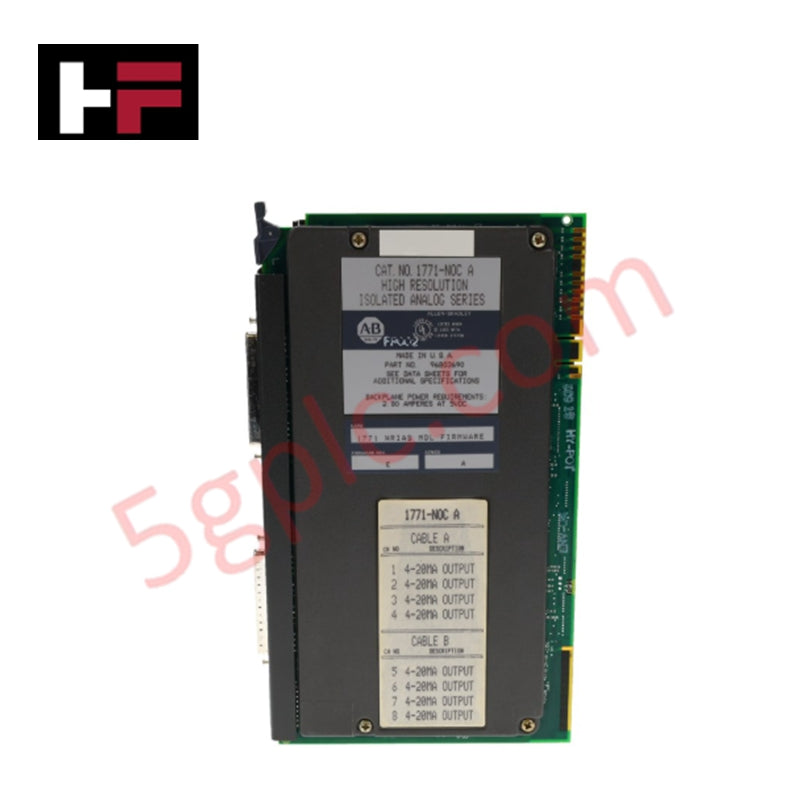
The Allen-Bradley 1771-NOC provides precise current sourcing for legacy PLC-5 control systems. This N-Series analog output module features 8 independent channels, each capable of sourcing up to 25 milliamperes. It delivers a resolution of 3.20 microamperes per bit, ensuring fine control over actuators and positioners. The module utilizes Binary Coded Decimal (BCD) or Natural Binary data formats, offering flexibility for different programming requirements. We supply this item as a 100% Brand New, factory-sealed unit.
Part Number Breakdown
-
1771: Identifies the PLC-5 / I/O Chassis system platform.
-
N: Denotes the N-Series (Analog) product family.
-
O: Specifies the function as Output.
-
C: Indicates the Current output type (0-25mA).
Technical Specifications
| Parameter | Specification |
|---|---|
| Manufacturer | Allen-Bradley (Rockwell Automation) |
| Module Type | N-Series Analog Output |
| Number of Outputs | 8 Channels |
| Output Type | Current Sourcing |
| Output Range | 0 - 25 mA |
| Resolution | 3.20 µA/bit |
| Backplane Current | 2.9 A (at 20 mA); 3.3 A (at 25 mA) |
| Data Format | BCD or Natural Binary |
| Signal Delay (Off) | 45 ms (AC) / 50 ms (DC) |
| Wiring Arm | 1771-WH |
| Weight | 1.75 lbs (0.79 kg) |
Engineering Advantages
High-Resolution Current Sourcing
The 1771-NOC specializes in sourcing current up to 25 mA, a range often required for specific pneumatic positioners, valve actuators, and legacy instrumentation. With a resolution of 3.20 µA/bit, the module provides smooth, step-free control signals. This precision minimizes hunting in control valves and ensures accurate positioning in analog loops.
Flexible Data Formatting
This module accommodates different programming strategies by supporting both Binary Coded Decimal (BCD) and Natural Binary data formats. You can select the format that best aligns with your PLC-5 processor's math instructions, simplifying ladder logic development and reducing the need for data conversion rungs.
Robust Backplane Integration
The unit draws significant current from the backplane—up to 3.3 Amps at full load—to drive high-impedance field loads. This internal power handling eliminates the need for complex external power wiring for the output stage. The module pairs with the 1771-WH wiring arm, ensuring secure, vibration-resistant connections to the field side.
FAQs
Q: What is the output signal range of the 1771-NOC?
A: The module sources a current signal ranging from 0 to 25 milliamperes. This is distinct from standard 4-20mA modules, making it suitable for specific devices requiring the extended 0-25mA range.
Q: Which wiring arm do I need for the 1771-NOC?
A: You must use the 1771-WH wiring arm (also known as the RTB or Remote Terminal Block). This arm connects to the back of the module and provides the screw terminals for your field wiring.
Q: Can I use this module for voltage output?
A: No. The 1771-NOC is designed strictly for current sourcing. If you require voltage output (e.g., 0-10V), you should select a different model from the 1771-N series specifically rated for voltage.
Q: How much backplane current does this module consume?
A: The module consumes 2.9 Amps when driving 20 mA per channel and up to 3.3 Amps when driving the full 25 mA per channel. Ensure your 1771 power supply has sufficient capacity to handle this load.
Additional Information
- 100% Genuine Parts: All products are original and authentic, ensuring reliable industrial performance.
- 30-Day Refund Guarantee: Return any in-stock item within 30 days in original, unopened packaging for a full refund (excluding shipping and fees).
- 12-Month Warranty: Covers defects in materials or workmanship; excludes misuse, normal wear, or unauthorized modifications.
- Worldwide Shipping: We ship via USPS, UPS, FedEx, and DHL. Delivery times vary by country and may be subject to customs or import fees.
- Support & Contact: Technical and warranty assistance is available anytime. Contact us here: Contact.
- Purchase Guidance: Check product specifications and compatibility carefully before ordering to ensure proper application.
Tech & Buying Guide

Step-by-Step System Cabinet Health Check Guide for PLC and DCS Infrastructure

Top 5 Operational Advantages of HMIs in Modern Factory Automation
