










Product Details
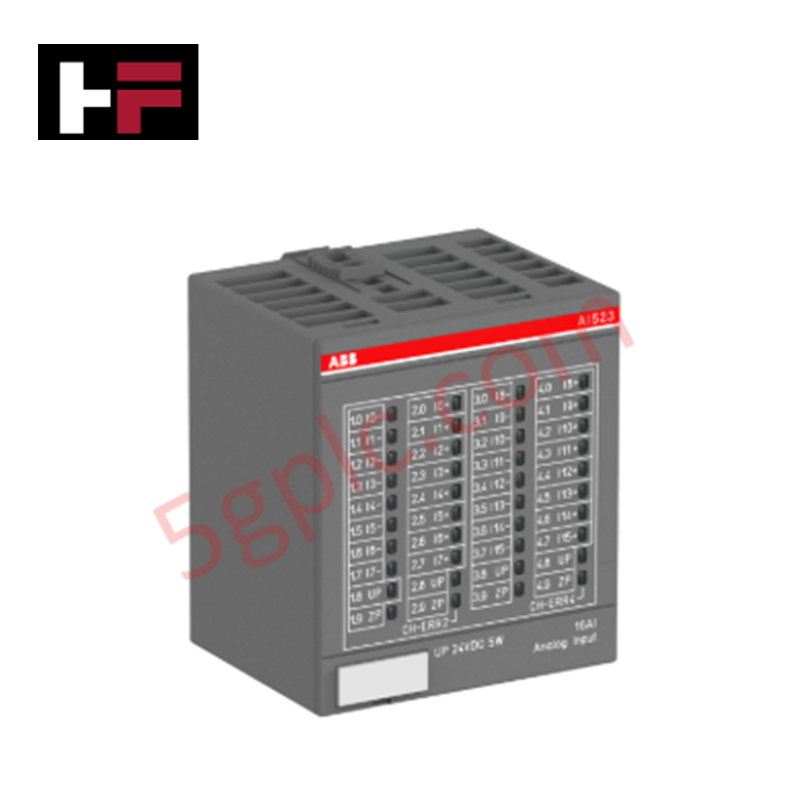
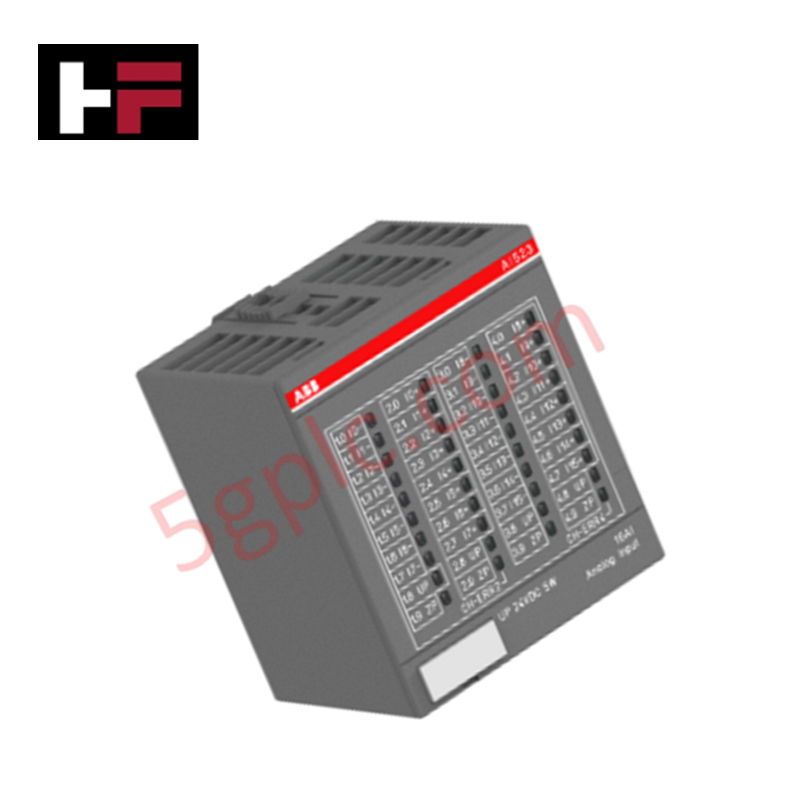
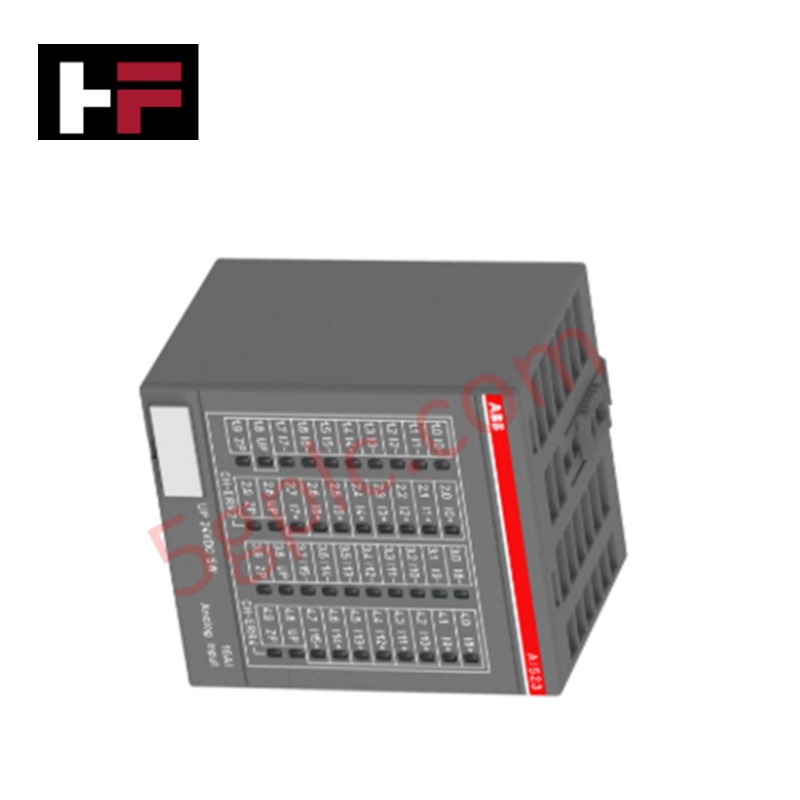
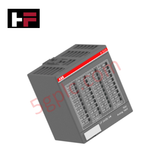
The ABB AO523 1SAP250200R0001, also cataloged as the AO523 Analog Output Module, serves as the primary AO523 Analog Output Module utilized to execute digital-to-analog signal modulation across S500 platform platforms. The unit converts internal system register commands into standard physical voltage and current signals via a 1-wire connection interface to regulate field actuator positions and drive control loops.
Hardware Specifications
| Parameter | Specification |
|---|---|
| Model | AO523 |
| Brand | ABB |
| Origin | Germany |
| Weight | 0.127 kg net / 0.152 kg gross |
| Dimensions | 67.5 mm x 76 mm x 62 mm (W x H x D) |
| Operating Temp | 0 to +60 deg C (Standard industrial baseline) |
| Power Consumption | Maintained via 24 VDC backplane bus connection |
| Number of Analog Outputs | 16 |
| Output Signal Types | 8 Channels: Voltage (U) or Current (I) selectable; 8 Channels: Voltage (U) fixed |
| Resolution | 13-bit including sign |
| Wiring Configuration | 1-wire |
| Degree of Protection | Housing IP20 |
Deterministic Networks & I/O Density Scaling
The internal physical architecture of the hardware is layout-optimized to enable precise I/O density scaling by packaging 16 independent output channels within a compact 67.5 mm width profile. Cyclic communication parameters are managed through Profinet / EtherNet/IP deterministic networks, which govern data packet transmission speeds based on active backplane bus communication velocity licenses. All internal digital-to-analog micro-circuits undergo strict hardware verification to enforce continuous firmware flash compatibility parameters when coupled with localized automation controllers.
Frequently Asked Questions
Q: Can the first 8 channels of the AO523 be mixed with voltage and current outputs at the same time?
A: Yes. The primary 8 channels are independent and can be individualistically parameterized for either voltage or current modes via the engineering software platform, while the remaining 8 channels are dedicated exclusively to voltage outputs.
Q: Is this module capable of being hot-swapped while the local bus segment is operational?
A: No. The assembly requires complete isolation from the 24 VDC bus power supply prior to mechanical extraction. Performing a hot-swap manipulation poses a risk of corrupting register sync cycles on the active backplane.
Q: How is the output resolution of 13 bits allocated for unipolar operations?
A: The 13-bit architecture includes a sign bit; hence, standard unipolar ranges map the physical signal span across 12 bits of magnitude resolution.
Field Installation Guidelines
- Snap the device securely onto standard 35 mm DIN rails, ensuring the rear metal ground spring makes direct contact with a clean, unpainted surface of the rail.
- Route all low-voltage analog output cables in separate cable tracks, maintaining a physical clearance distance of at least 100 mm from power lines and high-inductive switching circuits.
- Terminal terminations must follow the 1-wire topology outlined in the circuit layout schema; verify that all common return potentials converge correctly at the terminal base block.
- Field signaling cables must use shielded twisted-pair wire with the shield braid grounded at a single, low-resistance reference ground block inside the enclosure.
Additional Information
- 100% Genuine Parts: All products are original and authentic, ensuring reliable industrial performance.
- 30-Day Refund Guarantee: Return any in-stock item within 30 days in original, unopened packaging for a full refund (excluding shipping and fees).
- 12-Month Warranty: Covers defects in materials or workmanship; excludes misuse, normal wear, or unauthorized modifications.
- Worldwide Shipping: We ship via USPS, UPS, FedEx, and DHL. Delivery times vary by country and may be subject to customs or import fees.
- Support & Contact: Technical and warranty assistance is available anytime. Contact us here: Contact.
- Purchase Guidance: Check product specifications and compatibility carefully before ordering to ensure proper application.






Tech & Buying Guide

Demystifying the DDE Protocol in Legacy Industrial Automation Systems
Modern control systems rely heavily on seamless interprocess communication to exchange operational data between software programs. Microsoft first introduced the Dynamic Data Exchange (DDE) protocol in 1987 to enable real-time data sharing. In factory automation, DDE served as an early bridge between control software and Windows desktop applications. Therefore, understanding DDE mechanics provides crucial insights into how legacy industrial networks established software-level connectivity.

Demystifying CPU Communication Ports in Siemens PLC Architectures
Industrial automation relies heavily on robust data exchange between devices. Without seamless connectivity, field instruments, network switches, human-machine interfaces, and programmable logic controllers cannot coordinate effectively. Therefore, understanding the various CPU communication ports available in Siemens hardware ensures efficient factory automation design and seamless system integration.

Mastering the Siemens PLC Scan Cycle: How the CPU Executes Automation Programs
Industrial automation relies heavily on programmable logic controllers (PLCs) to manage complex manufacturing processes. Many engineers dive straight into programming without mastering the underlying architecture. However, understanding how a PLC CPU executes a program ensures reliable system design. Therefore, mastering the scan cycle optimizes both performance and troubleshooting in modern control systems.