










Understanding the Distributed Control System (DCS) in Modern Process Industries
- 〡
- 〡 by WUPAMBO

The landscape of factory automation and process control relies heavily on efficient control systems. While the Programmable Logic Controller (PLC) remains a staple for discrete machine control, large-scale process plants require a different architectural approach. This article examines the core concept of the Distributed Control System (DCS) and its functional role in complex industrial automation.
Evolution from Individual PLC Nodes to Unified DCS Architecture
In a typical production facility, single-loop control or isolated machine automation is easily managed by a standalone PLC. However, modern plants operate highly interdependent processes that require continuous, synchronized data exchange. For example, in a dairy processing facility, individual stages such as raw milk receiving, pasteurization, cooling, and packaging must operate as a cohesive unit.
Using multiple, isolated PLCs from various manufacturers to control these steps often introduces integration challenges. Engineers must configure complex communication protocols to share data between disparate hardware platforms.
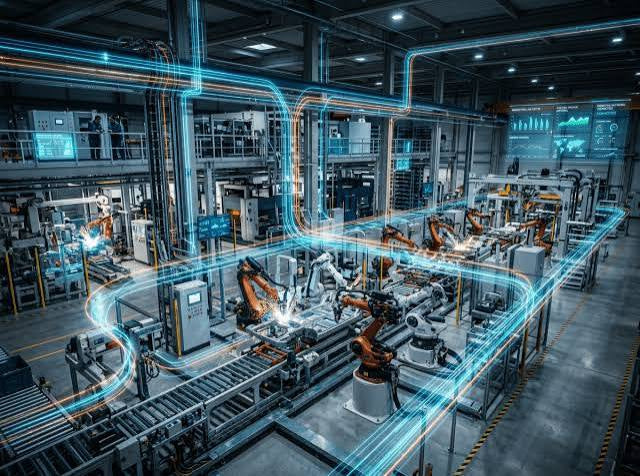
To resolve these integration bottlenecks, the industry developed the Distributed Control System. A DCS functions as a cohesive network of integrated, standardized controllers distributed throughout a plant. Each controller manages a specific process zone, communicating natively with peer controllers and centralized visualization systems over a high-speed, deterministic control network.
Multi-Tiered Network Topologies in Distributed Environments
A standard DCS operates through a structured, multi-tiered network architecture designed to ensure seamless data flow:
- Field Network Layer: This base layer consists of field instruments, sensors, control valves, and smart actuators. These devices utilize robust communication protocols like 4-20 mA HART, FOUNDATION Fieldbus, or Profibus PA to transmit physical process variables to the local controller.
- Controller Network Layer: Dedicated DCS controllers process local control loops, execute PID algorithms, and manage interlocking logic. These controllers share data horizontally with peer nodes on a deterministic network.
- Server and Supervisory Network Layer: Dedicated plant servers collect data from the controller layer, serving as the central repository for historical data, alarms, and system configurations. These servers distribute real-time data to Operator Stations (HMIs) and Engineering Workstations.
- Enterprise Integration Layer: At the highest level, the DCS interface connects to Manufacturing Execution Systems (MES) and Enterprise Resource Planning (ERP) platforms. This connection allows corporate networks to access operational data for production scheduling and asset management.
Architectural Comparison: DCS versus PLC Systems
Choosing between a PLC and a DCS depends largely on the specific requirements of the application:
| Feature / Metric | Programmable Logic Controller (PLC) | Distributed Control System (DCS) |
|---|---|---|
| Primary Focus | Discrete control, high-speed interlocking, machine automation | Continuous process control, complex loop regulation, system-wide integration |
| Processing Speed | Extremely fast (typically sub-millisecond scan times) | Moderate (optimized for analog loop execution and PID algorithms) |
| Database Structure | Split/Distributed (individual databases per PLC and HMI) | Unified global database (single-point configuration for logic and graphics) |
| I/O Capacity | Low to Moderate | High to Extremely High (capable of handling tens of thousands of physical and virtual I/O) |
| System Redundancy | Optional, often requires manual configuration | Standard, native support for redundant controllers, power supplies, and networks |
PLCs offer fast scan times, making them suitable for high-speed shutdown systems or discrete packaging machinery. However, configuring system-wide redundancy, managing a unified global database, and scaling up to thousands of analog I/O points can be difficult with a multi-PLC setup.
Conversely, a DCS provides a single, unified database environment. When an engineer configures an I/O point in a DCS controller, that point automatically populates across the alarm logs, trend displays, and operator graphics. This single-point configuration reduces engineering hours and minimizes configuration errors during commissioning.
Industry Applications and Solutions
Because of their high I/O density scaling and integrated redundancy, DCS networks are widely utilized in heavy process industries. Key sectors include:
- Oil and Gas Refineries: Managing fractional distillation columns, cracking units, and blending systems where precise temperature and pressure control are critical for safety and product quality.
- Chemical Processing Plants: Coordinating complex chemical reactions, batch sequencing, and feed-rate adjustments across multiple unit operations.
- Water and Wastewater Treatment: Monitoring expansive filtration systems, chemical dosing loops, and distribution networks across large geographical areas.
Technical Analysis: Selecting the Right System
For hybrid plants that feature both continuous process stages and high-speed packaging lines, a combined approach is often the most practical solution. In this scenario, high-speed PLCs manage the discrete packaging machinery and communicate vital status registers upstream to a supervisory DCS via industrial protocols like Modbus TCP or EtherNet/IP. This hybrid setup leverages the speed of the PLC alongside the advanced database integration and historical tracking capabilities of the DCS.
About the Author: Zhang Weimin
Zhang Weimin is a senior industrial automation engineer and technical writer with over 15 years of field experience in control system design, commissioning, and optimization. Specializing in large-scale DCS migrations, safety instrumented systems (SIS), and industrial network security, Zhang has successfully delivered automation projects across the petrochemical, power generation, and municipal water treatment sectors. He regularly contributes technical guides, white papers, and system-level comparison analyses to B2B industrial automation publications worldwide.




%20in%20Modern%20Process%20Industries)