












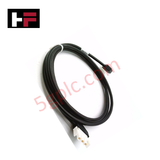
Product Details
The ABB NKTU01-L8, also cataloged as the NKTU01-L8 Shielded Communication Cable, operates as a dedicated hardware component for noise-resistant signal transmission between I/O modules and termination units within ABB Symphony Harmony INFI 90 platforms. The 8-foot shielded cable routes digital and low-voltage control signals directly across internal cabinet layouts, suppressing electromagnetic interference (EMI) and maintaining physical link integrity without signal degradation.
Hardware Specifications
| Parameter | Specification |
|---|---|
| Model | NKTU01-L8 |
| Brand | ABB |
| Cable Type | Shielded Communication Cable |
| Length | 8 ft (2.44 m) |
| Interface | Pre-terminated connectors |
| Function | Connects I/O module to termination unit |
| System Compatibility | ABB Symphony Harmony INFI 90 control systems |
| Shielding | EMI-resistant overall shielding |
| Operating Temp | -40 deg C to +70 deg C |
| Power Consumption | Passive physical connection (24 VDC nominal signal rating) |
| Dimensions | Cable length 2.44 m (8 ft) |
| Weight | Approx 0.9 kg |
| Origin | Sweden |
Deterministic Network Routing & Communication Integrity
The ABB NKTU01-L8 cable architecture maintains deterministic network routing across Symphony Harmony INFI 90 cabinet backplanes. The integrated foil and braided shielding suppress external high-frequency noise and channel-to-channel cross-talk, preserving communication velocity between active I/O cards and field termination assemblies. Onboard firmware flash compatibility within connected modules ensures seamless network initialization without data frame corruption or transmission retries during execution cycles.
Frequently Asked Questions
Q: What is the recommended minimum bend radius when installing the NKTU01-L8 cable inside compact control cabinets?
A: Maintain a minimum static bend radius of 10 times the outer cable diameter to avoid damaging the internal foil shield and twisted conductor geometry.
Q: Can the pre-terminated connectors of the NKTU01-L8 be connected or disconnected while the system is powered?
A: No. Signal cables connected to Symphony Harmony INFI 90 termination units should be handled only when the respective I/O rack power is isolated to prevent accidental ground loops or module reset states.
Q: How is the cable shield terminated to handle electromagnetic interference (EMI)?
A: The outer shield terminates directly to the metallic shell of the pre-terminated connectors, establishing a low-impedance ground path to the module housing upon seating.
Field Installation Guidelines
Follow standard industrial installation steps when deploying the communication cable:
- System Power Isolation: De-energize the host I/O rack and termination assembly power supplies before inserting or removing the cable connectors.
- Route Isolation: Run the NKTU01-L8 through designated low-voltage control wireways. Maintain at least 300 mm separation from 480 VAC power lines and VFD output cabling to minimize EMI coupling.
- Connector Engagement: Align the pre-terminated connector pins with the module socket. Push straight in until the locking clips engage securely.
- Strain Relief Application: Secure the cable jacket to enclosure mounting rails using industrial cable ties within 100 mm of the connector body to reduce mechanical stress.
Additional Information
- 100% Genuine Parts: All products are original and authentic, ensuring reliable industrial performance.
- 30-Day Refund Guarantee: Return any in-stock item within 30 days in original, unopened packaging for a full refund (excluding shipping and fees).
- 12-Month Warranty: Covers defects in materials or workmanship; excludes misuse, normal wear, or unauthorized modifications.
- Worldwide Shipping: We ship via USPS, UPS, FedEx, and DHL. Delivery times vary by country and may be subject to customs or import fees.
- Support & Contact: Technical and warranty assistance is available anytime. Contact us here: Contact.
- Purchase Guidance: Check product specifications and compatibility carefully before ordering to ensure proper application.




Tech & Buying Guide

Top 5 Operational Advantages of HMIs in Modern Factory Automation

Importance of Safety Barriers in PLC and DCS Control Systems
