Choosing the Right Controller: PLC vs. Motion Controller in Industrial Automation
- 〡
- 〡 by WUPAMBO
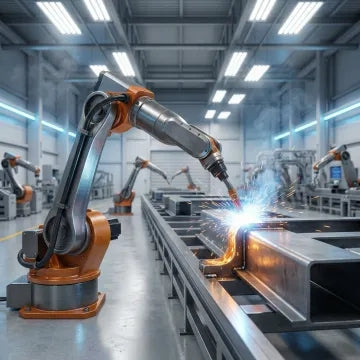
Selecting the optimal control architecture is a foundational decision in industrial automation. Engineers must frequently choose between a Programmable Logic Controller (PLC) and a dedicated Motion Controller. While both systems manage machinery, their underlying design philosophies differ significantly, impacting performance, scalability, and system integration.
Understanding Programmable Logic Controllers (PLCs)
The PLC acts as the backbone of modern factory automation. It typically features a robust processor, dedicated memory, and modular I/O interfaces to bridge the gap between sensors and actuators. Industry-standard programming languages—including Ladder Logic, Structured Text, and Function Block Diagrams—allow technicians to deploy control sequences reliably.
In my experience, PLCs excel in environments requiring deterministic I/O handling and long-term uptime. They provide a familiar environment for maintenance teams, simplifying troubleshooting and diagnostics. However, PLCs often face limitations regarding processing speed and complex algorithmic execution. For extremely high-speed axis synchronization, a standard PLC may require overly complex, inefficient code to achieve the necessary precision.
The Capabilities of Motion Controllers
Motion Controllers, often categorized as Programmable Automation Controllers (PACs), represent a paradigm shift in machine control. These units prioritize high-speed execution, complex trajectory planning, and sophisticated data acquisition. Unlike traditional PLCs, they offer open architectures that facilitate seamless integration with third-party components like servo drives, high-resolution cameras, and robotic arms.
From a technical perspective, motion controllers provide superior repeatability and reduced settling times. They manage multi-axis synchronization with microsecond latency, which is essential for modern high-throughput manufacturing lines. Their modular design allows engineers to scale I/O density without sacrificing the processing power required for advanced PID loops or kinematic calculations.
Key Technical Differences
The decision between these two platforms often comes down to the specific demands of the application. PLCs are usually the preferred choice for process automation, where steady-state control and reliability are paramount. Conversely, motion controllers dominate high-speed machine automation, such as precision laser cutting or high-speed labeling systems.
Moreover, motion controllers include advanced simulation environments, allowing engineers to validate algorithms before physical deployment. While you can technically program motion profiles into a PLC, it lacks the native computational efficiency and high-speed bus interfaces inherent to dedicated motion hardware. Therefore, using the correct tool for the task ensures better system efficiency and reduces long-term maintenance overhead.
Strategic Selection for Future-Proofing
As the industry shifts from traditional control systems toward AI-powered smart devices, the lines between PLCs and motion controllers continue to blur. High-end PLCs now feature motion modules, and motion controllers have adopted more PLC-like logic handling.
My recommendation is to evaluate the application's "degree of complexity." If the project involves standard interlock logic and steady-state process control, a high-performance PLC is sufficient. However, if your architecture requires millisecond-level synchronization, multi-axis interpolation, or integration with vision-based feedback, a dedicated motion controller will provide a more stable and scalable solution.
Application Scenarios
- Process Automation: Ideal for chemical mixing, pharmaceutical batching, and HVAC systems. These require robust sequence control and long-term stability provided by PLC platforms.
- High-Speed Machine Automation: Recommended for robotic pick-and-place, high-speed printing, and CNC machining. These demand the precision and low latency found in specialized motion control hardware.
About the Author
Li Ming (李明) is a seasoned expert in the global industrial automation sector with over 15 years of hands-on experience. His background spans the design and commissioning of complex control systems, including PLC, DCS, and power protection technologies. He regularly consults on digital transformation projects for major industrial manufacturers and contributes technical analyses to leading engineering publications.