












Product Details
Product Overview
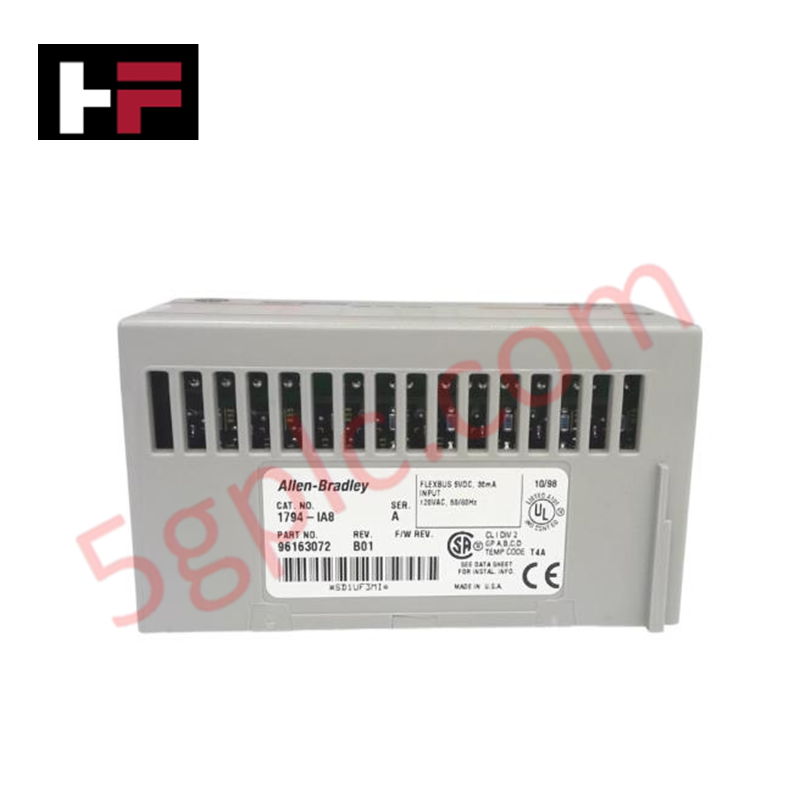
The Allen Bradley 1794-IA8 functions as a high-density discrete input interface for the Flex I/O platform. It translates 120V AC signals from field devices—such as limit switches, push buttons, and proximity sensors—into logic-level data for the controller. This unit arrives 100% Brand New and factory-sealed, ensuring immediate compatibility with your existing distributed I/O architecture.
Technical Specifications
The 1794-IA8 module utilizes a compact design to handle standard 120V AC industrial signaling.
| Feature | Specification |
| Manufacturer | Allen Bradley (Rockwell Automation) |
| Inputs | 8 Non-Isolated Channels |
| On-State Voltage Range | 65V AC (min) to 132V AC (max) |
| Nominal Input Current | 12 mA @ 120V AC |
| Off-State Voltage (max) | 43V AC |
| Flexbus Current | 30mA @ 5V DC |
| Power Dissipation | 4.5W @ 132V AC (max) |
| Operating Frequency | 47–63 Hz |
| Weight | 0.25 lbs (0.11 kg) |
Engineering Advantages
-
Modular Space Efficiency: The 1794-IA8 plugs directly into a terminal base, eliminating the need for internal rack wiring. This modularity reduces cabinet footprint and simplifies the transition from local to distributed I/O.
-
Aggressive Signal Filtering: The module incorporates hardware filtering to reject electrical noise common in AC power lines. It accurately distinguishes between true "On" states and transient voltage spikes, preventing false triggers in noisy industrial environments.
-
Simplified Troubleshooting: Individual status indicators on the front panel provide real-time visual confirmation of input activity. This allows maintenance teams to verify field-side wiring health without opening a laptop or accessing the PLC code.
-
Hot-Swap Capability: Within a powered Flex I/O system, the 1794-IA8 supports Removal and Insertion Under Power (RIUP). This feature enables technicians to replace modules without halting the entire process line, significantly reducing unplanned downtime.
FAQs
-
Can I mix AC and DC modules on the same Flex I/O terminal base?
The terminal base determines the wiring configuration, but the Flexbus allows different module types. However, you must ensure the terminal base (e.g., 1794-TB3) supports the voltage levels and wiring requirements of the 1794-IA8 AC input module specifically.
-
Does the 1794-IA8 provide isolation between individual channels?
No. The 1794-IA8 features 8 non-isolated inputs. This means the inputs share a common return path. If your application requires independent returns for each circuit to prevent ground loops or cross-talk, consider the isolated versions within the 1794 series.
-
What is the significance of the 43V AC off-state maximum?
This threshold ensures that leakage current from long cable runs or solid-state sensors does not cause the PLC to perceive a "false on" signal. The module ignores any voltage below 43V AC, providing a robust buffer against induced voltage.
-
What terminal bases are compatible with this module?
The 1794-IA8 typically seats into 1794-TB2, 1794-TB3, or 1794-TB3S terminal bases. Always verify that your base selection matches your field wiring termination style (screw or spring clamp).
Additional Information
- 100% Genuine Parts: All products are original and authentic, ensuring reliable industrial performance.
- 30-Day Refund Guarantee: Return any in-stock item within 30 days in original, unopened packaging for a full refund (excluding shipping and fees).
- 12-Month Warranty: Covers defects in materials or workmanship; excludes misuse, normal wear, or unauthorized modifications.
- Worldwide Shipping: We ship via USPS, UPS, FedEx, and DHL. Delivery times vary by country and may be subject to customs or import fees.
- Support & Contact: Technical and warranty assistance is available anytime. Contact us here: Contact.
- Purchase Guidance: Check product specifications and compatibility carefully before ordering to ensure proper application.
Tech & Buying Guide

Demystifying the DDE Protocol in Legacy Industrial Automation Systems
Modern control systems rely heavily on seamless interprocess communication to exchange operational data between software programs. Microsoft first introduced the Dynamic Data Exchange (DDE) protocol in 1987 to enable real-time data sharing. In factory automation, DDE served as an early bridge between control software and Windows desktop applications. Therefore, understanding DDE mechanics provides crucial insights into how legacy industrial networks established software-level connectivity.

Demystifying CPU Communication Ports in Siemens PLC Architectures
Industrial automation relies heavily on robust data exchange between devices. Without seamless connectivity, field instruments, network switches, human-machine interfaces, and programmable logic controllers cannot coordinate effectively. Therefore, understanding the various CPU communication ports available in Siemens hardware ensures efficient factory automation design and seamless system integration.

Mastering the Siemens PLC Scan Cycle: How the CPU Executes Automation Programs
Industrial automation relies heavily on programmable logic controllers (PLCs) to manage complex manufacturing processes. Many engineers dive straight into programming without mastering the underlying architecture. However, understanding how a PLC CPU executes a program ensures reliable system design. Therefore, mastering the scan cycle optimizes both performance and troubleshooting in modern control systems.