












Product Details
Product Overview
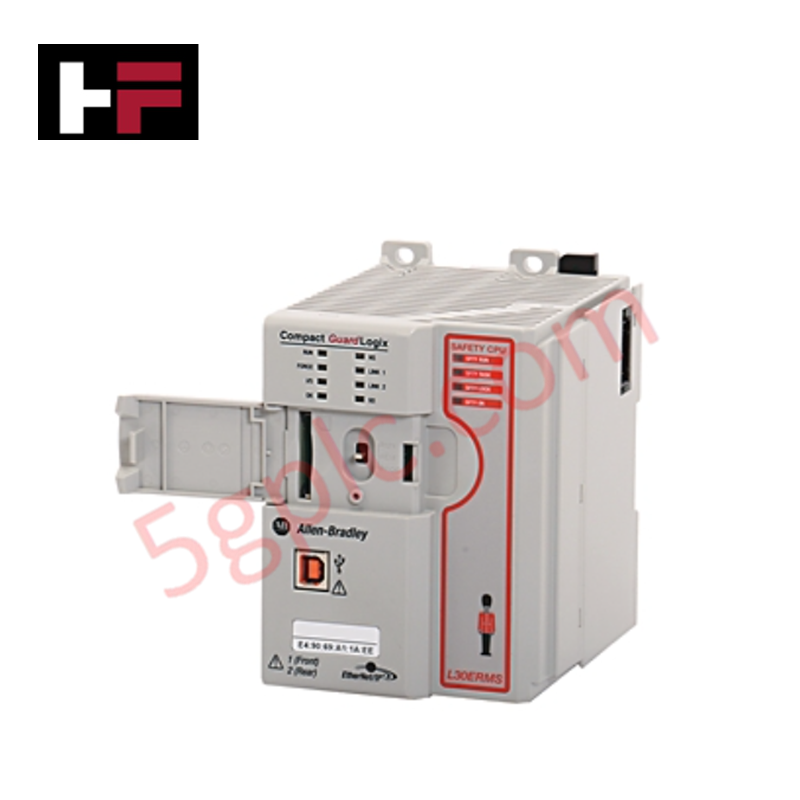
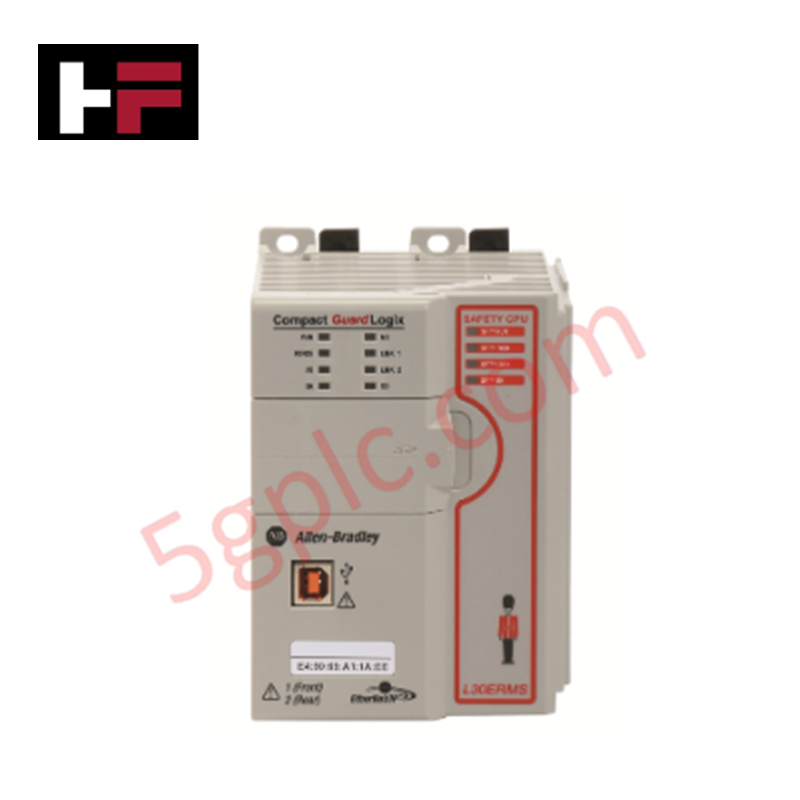
The Allen Bradley 1769-L33ERMS functions as a high-performance Compact GuardLogix safety controller designed for mid-range applications requiring integrated safety and motion control. It delivers a dual-core processing solution that manages standard and safety functions on a single platform. This controller achieves SIL 3 and PLe (Performance Level e) ratings, providing high-integrity protection for complex machinery. By supporting up to 8 axes of integrated motion over Ethernet/IP, the 1769-L33ERMS streamlines the architecture of modern automated cells.
Technical Specifications
| Feature | Detailed Specification |
| Manufacturer | Allen Bradley / Rockwell Automation |
| Part Number | 1769-L33ERMS |
| Safety Integrity Level | SIL 3 / PLe |
| Standard User Memory | 2 MB |
| Safety User Memory | 1 MB |
| Non-Volatile Memory | 1 GB (via included 1784-SD1 card) |
| Integrated Motion | Up to 8 Axes |
| Ethernet/IP Nodes | 32 Nodes |
| Local I/O Capacity | 16 Modules |
| Communication Ports | Dual Ethernet/IP, 1 USB 2.0 (Type B) |
| Programming | Ladder, Structured Text, Function Block, SFC |
| Condition | 100% Brand New Original |
Engineering Advantages
-
Converged Control Architecture: The 1769-L33ERMS integrates safety, discrete, and motion control into one unit. This consolidation reduces cabinet hardware requirements, simplifies system wiring, and lowers the total cost of ownership for machine builders.
-
High-Speed Safety Response: Dedicated safety memory (1 MB) and SIL 3 certification ensure the controller executes safety logic with priority and precision. This provides rapid shutdown responses during E-stop or light curtain triggers, enhancing operator protection.
-
Scalable Motion Over Ethernet/IP: The unit manages up to 8 motion axes natively. It eliminates the need for dedicated motion modules or specialized sub-networks, allowing engineers to synchronize drives and actuators over standard industrial Ethernet infrastructure.
-
Simplified Maintenance and Recovery: Each controller ships with a 1784-SD1 1GB SD card. This allows for automated firmware updates and non-volatile storage of the entire user project. In the event of a hardware swap, maintenance teams restore operations by simply transferring the SD card to a new unit.
-
Versatile Programming Options: Supporting four IEC 61131-3 languages, the 1769-L33ERMS allows developers to select the most efficient logic format for their specific application, whether it involves complex mathematical algorithms or straightforward sequential machine steps.
FAQs
-
Is this 1769-L33ERMS unit brand new?
Yes. We supply this controller as 100% Brand New in original factory-sealed packaging. Each unit includes the 1784-SD1 memory card as standard equipment.
-
Does this controller support Device Level Ring (DLR) topology?
Yes. The dual Ethernet ports allow the 1769-L33ERMS to function as a node in a DLR network. This provides cable redundancy and ensures the network remains operational even if a single physical link fails.
-
How many local I/O modules can I connect?
The 1769-L33ERMS supports up to 16 local 1769 Compact I/O modules. Ensure you calculate the power supply distance rating for your specific module configuration to maintain signal integrity.
-
Can I use this for non-safety applications?
While the 1769-L33ERMS excels in safety environments, it functions perfectly as a standard high-performance controller. The additional safety memory and motion capabilities make it an ideal choice for future-proofing your automation systems.
Additional Information
- 100% Genuine Parts: All products are original and authentic, ensuring reliable industrial performance.
- 30-Day Refund Guarantee: Return any in-stock item within 30 days in original, unopened packaging for a full refund (excluding shipping and fees).
- 12-Month Warranty: Covers defects in materials or workmanship; excludes misuse, normal wear, or unauthorized modifications.
- Worldwide Shipping: We ship via USPS, UPS, FedEx, and DHL. Delivery times vary by country and may be subject to customs or import fees.
- Support & Contact: Technical and warranty assistance is available anytime. Contact us here: Contact.
- Purchase Guidance: Check product specifications and compatibility carefully before ordering to ensure proper application.
Tech & Buying Guide

Understanding VFD Mechanical Brake Logic and Control in Industrial Automation
Variable Frequency Drives (VFDs) play a crucial role in modern industrial automation by controlling motor speed, torque, and acceleration. However, high-inertia loads and vertical lifting systems require precise mechanical braking logic to ensure operational safety and prevent equipment damage.

Why Programmable Logic Controllers Drop into Stop Mode: An Expert Analysis
Industrial automation systems rely heavily on Programmable Logic Controllers (PLCs) to maintain uninterrupted production. When a PLC unexpectedly shifts from Run to Stop mode, whole manufacturing lines stall.
As control systems evolve across modern factory automation, understanding the root causes of these interruptions helps engineers minimize costly downtime. This technical guide breaks down why PLCs trip into Stop mode and provides practical strategies to mitigate system faults.

Understanding Root Causes of Unplanned PLC Stop Mode in Industrial Automation
Modern Programmable Logic Controllers manage execution through distinct operational states: Run, Stop, Start-Up, and Hold. During power-up, a controller initializes memory registers within Stop mode before briefly transitioning to Start-Up mode. During this phase, internal self-diagnostics evaluate system integrity across hardware and user programs. If the controller detects no critical faults, it enters Run mode to execute the control program continuously. However, any severe system anomaly forces the CPU back into Stop mode immediately to prevent erratic machine behavior across the plant floor.