













Product Details
Product Overview
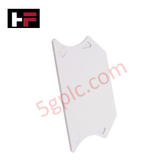
The 1492-EBJ3 functions as the essential finishing component for the Allen-Bradley 1492 screw-type terminal block assembly. This end barrier provides the necessary insulation and physical closure for the open side of a terminal block stack. It prevents accidental contact with live internal bus bars and ensures the entire DIN rail assembly meets industrial safety standards. We supply this unit as 100% Brand New original hardware, guaranteeing a precise mechanical fit and consistent dielectric protection for your control panel wiring.
Technical Specifications
The 1492-EBJ3 features a low-profile design optimized for high-density DIN rail configurations:
| Parameter | Specification |
| Manufacturer | Allen-Bradley / Rockwell Automation |
| Part Number | 1492-EBJ3 |
| Product Type | Terminal Block End Barrier |
| Compatible Style | Screw-Type Terminal Blocks (J3 Series) |
| Mounting Type | Snap-on Mounting |
| Dimensions | 1.5 x 33.35 x 60 mm |
| Color | Gray |
| Weight | 0.04 lbs (approx. 18g) |
| Material | High-Grade Industrial Polyamide |
Engineering Advantages
-
Enhanced Finger Safety: The 1492-EBJ3 seals the exposed conductive parts of the last terminal block in a row. This creates an IP20-rated touch-safe environment, protecting maintenance personnel from electrical shock during routine inspections.
-
Instant Snap-On Integration: The tool-less mounting design allows for rapid installation. Technicians simply snap the barrier onto the end of the terminal stack, where it locks securely into place without additional fasteners.
-
Effective Creepage & Clearance: By physically separating adjacent circuits and closing off the stack, this barrier maintains required creepage and clearance distances. This prevents electrical arcing between high-voltage blocks and grounded enclosure surfaces.
-
Durable Industrial Construction: The high-grade gray polyamide material resists mechanical impacts and withstands the thermal fluctuations common in industrial control cabinets.
-
Standardized Form Factor: The 1.5mm thickness minimizes the horizontal footprint on the DIN rail. This allows engineers to maximize terminal density while still adhering to strict electrical isolation protocols.
Installation Guidelines
-
Placement: Identify the open side of the final 1492-J3 (or compatible) terminal block in your DIN rail assembly.
-
Alignment: Align the 1492-EBJ3 profile with the shape of the terminal block. Ensure the locking tabs line up with the corresponding recesses on the block.
-
Engagement: Press the barrier firmly against the block until the snap-on mechanism engages. The barrier must sit flush against the terminal block to provide a complete seal.
-
Final Check: Verify that no conductive bus bars or metal parts remain visible from the side of the assembly.
FAQs
Q: Why do I need the 1492-EBJ3 for my terminal block stack?
A: IEC-style terminal blocks typically feature one open side to facilitate internal bridging. The 1492-EBJ3 closes this open side, preventing short circuits and providing necessary electrical insulation for the end of the row.
Q: Is the 1492-EBJ3 compatible with spring-clamp (finger-safe) blocks?
A: The 1492-EBJ3 specifically matches the profile of screw-type terminal blocks, such as the 1492-J3 series. Spring-clamp modules usually require a different barrier profile tailored to their specific housing dimensions.
Q: Can I use this barrier to separate different voltage levels on the same rail?
A: Yes. Beyond serving as an end cap, engineers often insert the 1492-EBJ3 between groups of terminal blocks to provide a physical and visual divider between different circuit types or voltage levels.
Q: Does this end barrier require a DIN rail end anchor?
A: While the 1492-EBJ3 snaps onto the block itself, you should always use an end anchor (like the 1492-EAJ35) to keep the entire terminal block assembly and the end barrier from sliding along the DIN rail.
Additional Information
- 100% Genuine Parts: All products are original and authentic, ensuring reliable industrial performance.
- 30-Day Refund Guarantee: Return any in-stock item within 30 days in original, unopened packaging for a full refund (excluding shipping and fees).
- 12-Month Warranty: Covers defects in materials or workmanship; excludes misuse, normal wear, or unauthorized modifications.
- Worldwide Shipping: We ship via USPS, UPS, FedEx, and DHL. Delivery times vary by country and may be subject to customs or import fees.
- Support & Contact: Technical and warranty assistance is available anytime. Contact us here: Contact.
- Purchase Guidance: Check product specifications and compatibility carefully before ordering to ensure proper application.
Tech & Buying Guide

Demystifying the DDE Protocol in Legacy Industrial Automation Systems
Modern control systems rely heavily on seamless interprocess communication to exchange operational data between software programs. Microsoft first introduced the Dynamic Data Exchange (DDE) protocol in 1987 to enable real-time data sharing. In factory automation, DDE served as an early bridge between control software and Windows desktop applications. Therefore, understanding DDE mechanics provides crucial insights into how legacy industrial networks established software-level connectivity.

Demystifying CPU Communication Ports in Siemens PLC Architectures
Industrial automation relies heavily on robust data exchange between devices. Without seamless connectivity, field instruments, network switches, human-machine interfaces, and programmable logic controllers cannot coordinate effectively. Therefore, understanding the various CPU communication ports available in Siemens hardware ensures efficient factory automation design and seamless system integration.

Mastering the Siemens PLC Scan Cycle: How the CPU Executes Automation Programs
Industrial automation relies heavily on programmable logic controllers (PLCs) to manage complex manufacturing processes. Many engineers dive straight into programming without mastering the underlying architecture. However, understanding how a PLC CPU executes a program ensures reliable system design. Therefore, mastering the scan cycle optimizes both performance and troubleshooting in modern control systems.