












Product Details
Product Description
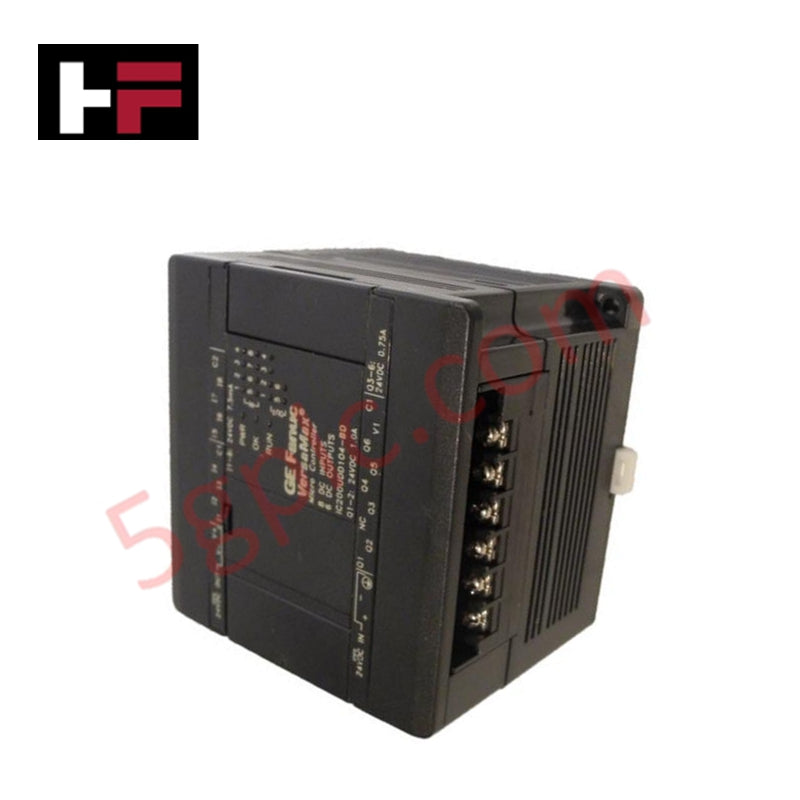
The GE Fanuc VersaMax IC200UDD104 is a compact Micro PLC processor module designed for small to mid-scale automation systems. It integrates 14 total I/O points, supports expansion modules, and provides flexible voltage outputs for diverse control applications. With built-in communication capability and efficient power consumption, this processor module ensures reliable performance in distributed control environments.
Technical Specifications
-
Manufacturer: GE Fanuc Emerson
-
Model / Part Number: IC200UDD104
-
Product Line: VersaMax
-
Product Type: Micro PLC Processor Module
-
Weight: 2.00 lbs (0.91 kg)
-
Total I/O Points: 14 (8 inputs, 6 outputs)
-
Expansion Capacity: Supports up to 4 expansion units
-
Maximum Physical I/O: 126 points
-
Input Voltage: 24 VDC
-
Output Voltage: 12/24 VDC
-
Power Voltage: 24 VDC
-
Input Power Rating: 4 W
-
Serial Port Connector: RJ-45 (RS-232)
-
Communication: Integrated serial interface for external device connectivity
Application Scenarios
The IC200UDD104 is suitable for compact automation systems such as packaging machinery, conveyor control, and small process monitoring. Its expansion capability makes it adaptable for growing systems, while its built-in communication port allows integration with external devices.
FAQ
Q: How many expansion units can be added? A: Up to 4 expansion units can be connected, supporting a maximum of 126 physical I/O points.
Q: What communication interface is included? A: The module features an RJ-45 RS-232 serial port.
Q: What is the total I/O capacity of the base unit? A: It provides 14 I/O points (8 inputs and 6 outputs).
Comparison with Similar Models
-
IC200UDD110: Offers higher I/O density and additional communication options.
-
IC200UDD102: Smaller configuration with fewer I/O points, ideal for minimal systems. The IC200UDD104 balances compact design with expansion capability for mid-range automation needs.
Additional Information
- 100% Genuine Parts: All products are original and authentic, ensuring reliable industrial performance.
- 30-Day Refund Guarantee: Return any in-stock item within 30 days in original, unopened packaging for a full refund (excluding shipping and fees).
- 12-Month Warranty: Covers defects in materials or workmanship; excludes misuse, normal wear, or unauthorized modifications.
- Worldwide Shipping: We ship via USPS, UPS, FedEx, and DHL. Delivery times vary by country and may be subject to customs or import fees.
- Support & Contact: Technical and warranty assistance is available anytime. Contact us here: Contact.
- Purchase Guidance: Check product specifications and compatibility carefully before ordering to ensure proper application.


Tech & Buying Guide

Understanding Modern SCADA Systems: Architecture, Communication Topologies, and Industrial Applications
Supervisory Control and Data Acquisition (SCADA) systems form the digital backbone of modern industrial automation. They collect critical field data, transmit signals across vast distances, and empower plant operators with real-time process visibility. Across modern infrastructures, SCADA solutions streamline centralized control and maintain continuous operational uptime.

Understanding OPC Servers in Modern Industrial Automation: Principles, Architecture, and Applications
In industrial automation, connecting physical hardware with high-level software remains a primary operational challenge. Factories utilize programmable logic controllers (PLCs), distributed control systems (DCS), human-machine interfaces (HMIs), and smart sensors from diverse vendors. These devices often speak different proprietary protocols. Open Platform Communications (OPC) servers solve this interoperability challenge by standardizing how data flows across factory networks.

Industrial Fiber Optic Cables: Principles, Connectors, and Fusion Splicing Techniques
Modern factory automation relies heavily on fiber optic cables for high-speed industrial data transmission. Fiber optic cables transmit light pulses instead of electrical signals, eliminating electromagnetic interference (EMI) risks completely. Each optical strand consists of a high-purity glass core surrounded by a protective cladding layer. The difference in refractive index between core and cladding enables total internal reflection. Protective resin buffers, Kevlar strength members, and rugged outer jackets safeguard delicate glass cores in harsh environments. Consequently, automation engineers prefer fiber backbones for reliable noise-free communication in industrial control systems.