










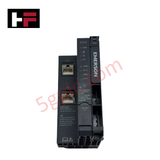
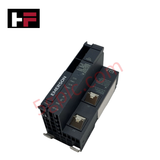
Product Details
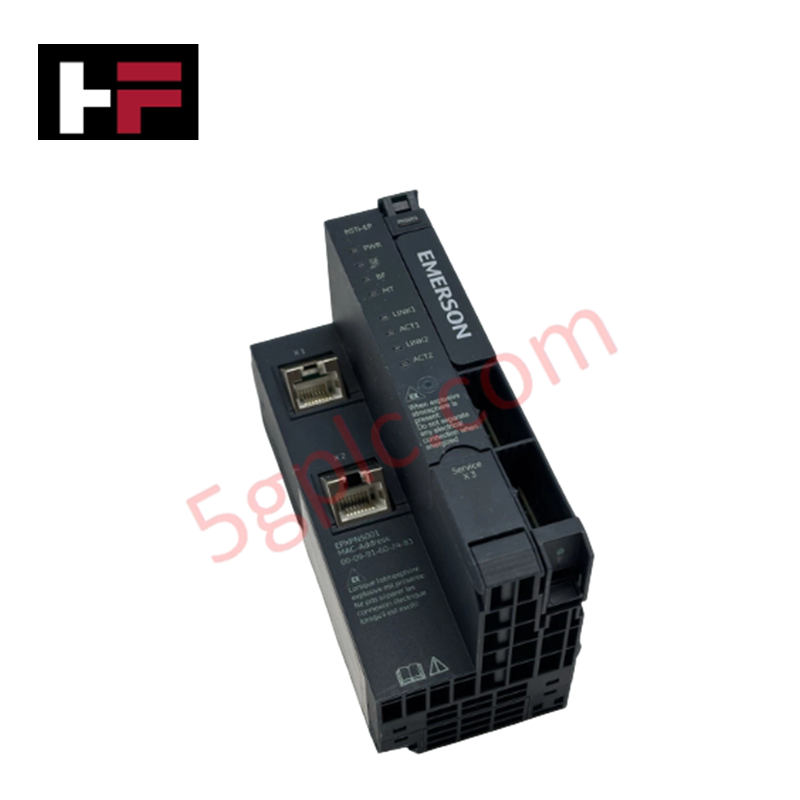
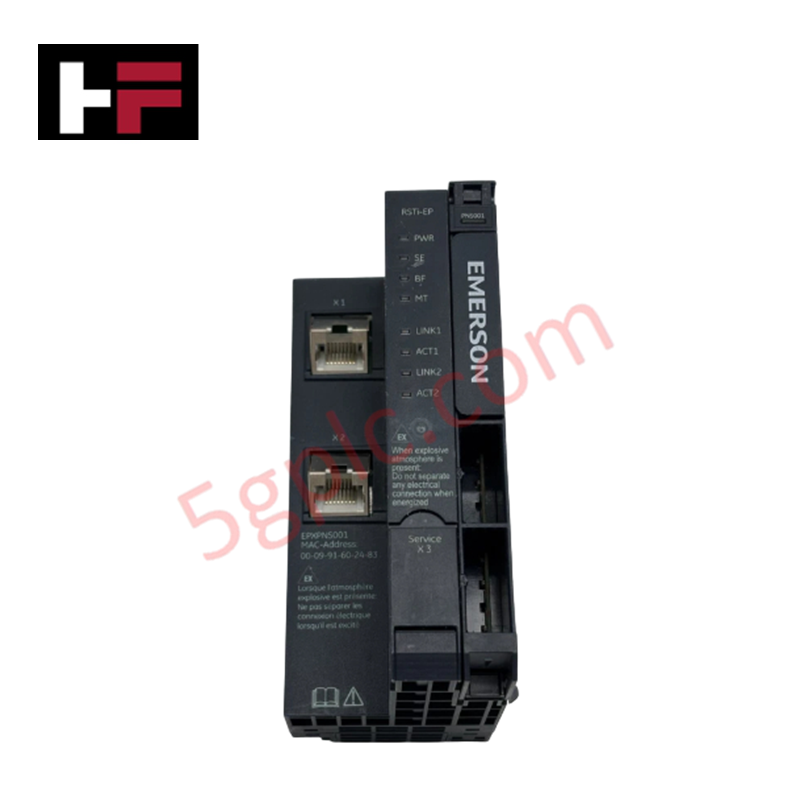
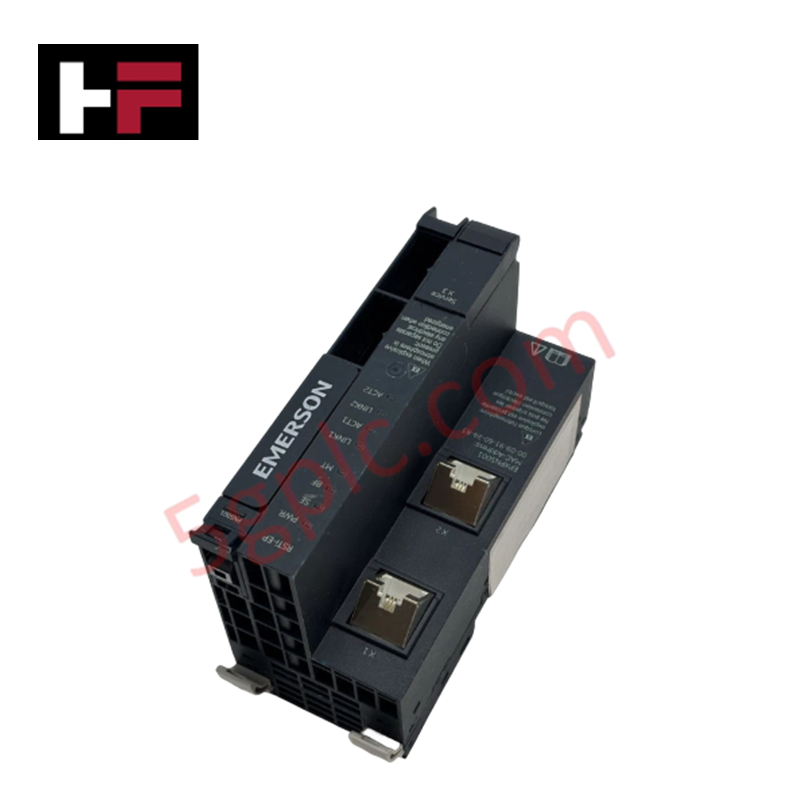
Configured for fieldbus network integration in PACSystems RSTi-EP platforms, the Emerson EPXPNS001 (EPXPNS001 PROFINET Scanner) provides direct physical/electrical execution. It establishes high-speed deterministic data transfer between the central controller and up to 64 local I/O modules via dual RJ-45 interfaces.
Hardware Specifications
| Parameter | Specification |
|---|---|
| Model | EPXPNS001 |
| Brand | Emerson |
| Base Model | EPXPNS001 |
| Origin | USA |
| Weight | 220 g (7.76 oz) |
| Dimensions | 52 mm x 76 mm x 120 mm |
| Operating Temp | -20 to +60 deg C (-4 to +140 deg F) |
| Power Consumption | Current consumption from system path (ISYS): 116 mA |
| Supply Voltage | System/Inputs/Outputs: 20.4 VDC to 28.8 VDC |
| Fieldbus Protocol | PROFINET Version 2.3 Class C I/O Device (IRT, RT) |
| Physical Interface | 2 x RJ-45 ports, Micro USB 2.0 configuration interface |
| Transfer Rate | Fieldbus: 100 Mbps max; System Bus: 48 Mbps max |
| Process Image | Max 512 bytes input, max 512 bytes output |
| Max Module Capacity | Up to 64 active I/O modules |
| Feed-in Current | Max 10 A for input modules, max 10 A for output modules |
| Relative Humidity | 5% to 95% non-condensing (DIN EN 61131-2) |
Profinet / EtherNet/IP Deterministic Networks and I/O Density Scaling
The EPXPNS001 PROFINET Scanner maintains deterministic communication profiles using PROFINET Version 2.3 Class C protocol (RT/IRT) with selectable update rates down to 1 ms. Supporting Media Redundancy Protocol (MRP) ring topologies, the module handles process image exchanges of up to 512 bytes input and 512 bytes output. It scales I/O density by managing up to 64 local slices, bridging high-speed 100 Mbps network traffic down to the 48 Mbps RSTi-EP local system bus via galvanically isolated physical layers.
Frequently Asked Questions
Q: What is the minimum PROFINET I/O update rate required for bumpless operation in an MRP ring topology?
A: The minimum recommended I/O update rate for bumpless failover in a Media Redundancy Protocol (MRP) ring configuration is 32 ms or slower for the EPXPNS001 scanner.
Q: How do the PWR, SF, and BF LED indicators reflect the hardware operational status?
A: A solid green PWR LED indicates active logic supply; a solid red SF LED indicates a system fault, scanner module error, or active force mode; and a solid red BF LED signals a loss of physical connection to the fieldbus network.
Q: What wire gauge range is supported by the spring-style connection terminals?
A: The spring-style terminals accept single-wired or fine-wired conductors with cross-sections ranging from 0.14 mm2 to 1.5 mm2 (AWG 26 to AWG 16).
Field Installation Guidelines
- Mount the scanner onto a standard 35 mm DIN rail inside a protective industrial panel enclosure.
- Connect the 20.4 VDC to 28.8 VDC power supply wires to the spring terminals, ensuring proper wire strip lengths between 0.14 mm2 and 1.5 mm2.
- Insert RJ-45 Ethernet network cables into Port 1 and Port 2 until the locking tabs snap securely.
- Align adjacent RSTi-EP I/O module slice connectors and slide them firmly onto the right side of the scanner to engage the internal system bus.
- Connect the functional earth terminal to the central enclosure ground rail to ensure full noise immunity and surge suppression.
Additional Information
- 100% Genuine Parts: All products are original and authentic, ensuring reliable industrial performance.
- 30-Day Refund Guarantee: Return any in-stock item within 30 days in original, unopened packaging for a full refund (excluding shipping and fees).
- 12-Month Warranty: Covers defects in materials or workmanship; excludes misuse, normal wear, or unauthorized modifications.
- Worldwide Shipping: We ship via USPS, UPS, FedEx, and DHL. Delivery times vary by country and may be subject to customs or import fees.
- Support & Contact: Technical and warranty assistance is available anytime. Contact us here: Contact.
- Purchase Guidance: Check product specifications and compatibility carefully before ordering to ensure proper application.




Tech & Buying Guide

Marshalling Cabinet Preventive Maintenance: Essential Healthiness Checks for PLC, DCS, and ESD Systems
Marshalling cabinets serve as the vital interface between field instrumentation and control room electronics in modern process facilities. Regular preventive maintenance of these cabinets ensures signal integrity across programmable logic controllers (PLCs), distributed control systems (DCS), and emergency shutdown (ESD) networks. System technicians must execute structured inspection protocols to mitigate environmental risks, identify loose wiring, and maintain continuous operational readiness.

Spatial Computing in Industrial Automation: Elevating PLC and DCS Operations with AR and VR
Industry 4.0 integrates digital intelligence into field operations, transforming factory automation landscapes worldwide. Spatial technologies—specifically Augmented Reality (AR) and Virtual Reality (VR)—redefine how engineers interact with industrial control systems. By bridging computer-generated CAD models with real-time operational technology (OT) data, immersive displays enable intuitive monitoring, rapid diagnostics, and safer maintenance across complex processing facilities.

Master Acceptance Testing: Understanding FAT and SAT in Industrial Control Systems
Factory Acceptance Testing (FAT) and Site Acceptance Testing (SAT) serve as critical quality assurance gateways in complex industrial control systems. Both procedures verify that programmable logic controllers (PLCs), distributed control systems (DCS), and associated field devices meet strict functional specifications. However, executing these tests effectively requires clear delineation between off-site staging and final field commissioning.