














Product Details
Product Description
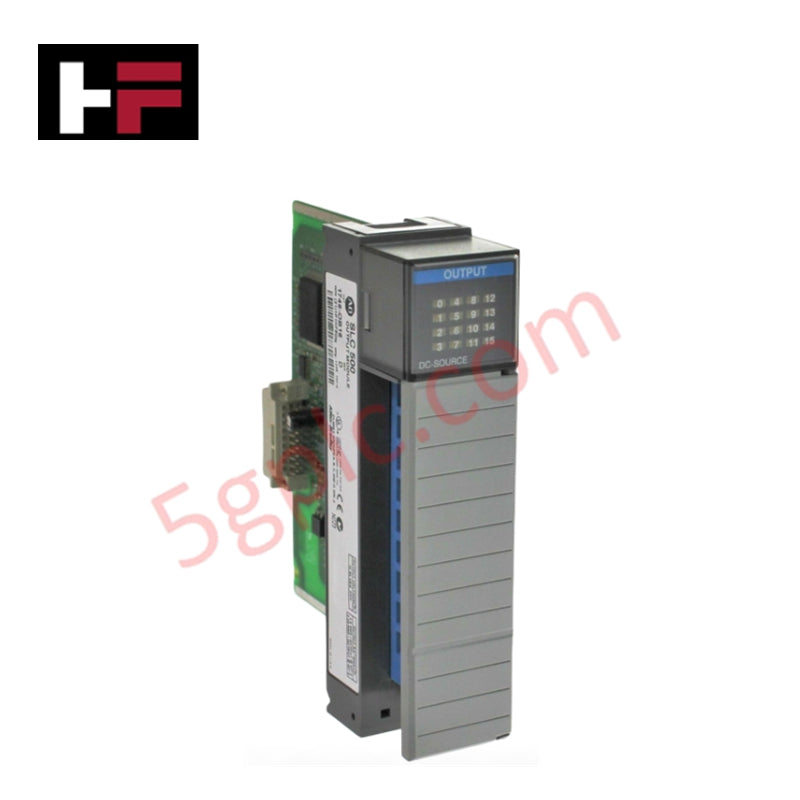
The 1746-ITB16 (Part Number 1746-ITB16) is a high-performance, discrete input module engineered for the Allen-Bradley SLC 500 controller platform. Unlike standard DC input modules, this "Fast Response" version is specifically optimized for high-speed industrial applications where minimal signal latency is critical. It provides 16 high-density input points in a sink wiring configuration, allowing for rapid detection of sensor states and high-speed pulse inputs within the 24V DC nominal range.
The module is designed for reliability in demanding environments, featuring an extremely low signal delay—just 0.3 milliseconds for the "On" state transition. This speed makes the 1746-ITB16 an ideal choice for machinery involving high-speed counting, precision positioning, or rapid cycle times. It interfaces directly with the SLC 500 backplane, drawing a minimal 85 mA current, which preserves power budget for other chassis components.
Technical Specifications
-
Series: SLC 500 I/O
-
Model Number: 1746-ITB16
-
Module Architecture: Fast-Response Discrete Input
-
Number of Inputs: 16 Channels
-
Wiring Configuration: Sinking (Sink)
-
Nominal Input Voltage: 24V DC
-
Operational Voltage Range: 10 to 30V DC
-
Maximum Off-State Voltage: 5V DC
-
Maximum Off-State Current: 1.5 mA
-
Nominal Input Current: 8 mA @ 24V DC
-
Signal Propagation Delay (Resistive): On = 0.3 ms / Off = 0.5 ms
-
Backplane Current Draw: 85 mA @ 5V DC
-
Thermal Dissipation: Approx. 0.2 Watts per point
-
Physical Weight: 0.26 kg (0.56 lbs)
-
Status Indicators: Integrated LED array for channel verification
Implementation and Maintenance
When installing the 1746-ITB16, engineers should prioritize its use for inputs that trigger high-priority tasks or fast-acting logic rungs. Because it is a sinking module, the field device must be of the sourcing (PNP) type. This module is compatible with all SLC 500 chassis and can be used alongside AC or relay modules to create a comprehensive I/O solution.
Engineering FAQ
How does the 1746-ITB16 differ from the standard 1746-IB16?The primary difference is the signal delay. While a standard 1746-IB16 typically has an 8ms delay to filter out contact bounce, the 1746-ITB16 features a 0.3ms delay. This enables the controller to respond to millisecond-level changes in sensor data.
Does this module require external power for its logic?No. The logic-side circuitry is powered through the SLC 500 backplane. However, 24V DC field power must be supplied to the sensors or switches connected to the input terminals to complete the circuit.
Additional Information
- 100% Genuine Parts: All products are original and authentic, ensuring reliable industrial performance.
- 30-Day Refund Guarantee: Return any in-stock item within 30 days in original, unopened packaging for a full refund (excluding shipping and fees).
- 12-Month Warranty: Covers defects in materials or workmanship; excludes misuse, normal wear, or unauthorized modifications.
- Worldwide Shipping: We ship via USPS, UPS, FedEx, and DHL. Delivery times vary by country and may be subject to customs or import fees.
- Support & Contact: Technical and warranty assistance is available anytime. Contact us here: Contact.
- Purchase Guidance: Check product specifications and compatibility carefully before ordering to ensure proper application.
Tech & Buying Guide

Why Programmable Logic Controllers Drop into Stop Mode: An Expert Analysis
Industrial automation systems rely heavily on Programmable Logic Controllers (PLCs) to maintain uninterrupted production. When a PLC unexpectedly shifts from Run to Stop mode, whole manufacturing lines stall.
As control systems evolve across modern factory automation, understanding the root causes of these interruptions helps engineers minimize costly downtime. This technical guide breaks down why PLCs trip into Stop mode and provides practical strategies to mitigate system faults.

Understanding Root Causes of Unplanned PLC Stop Mode in Industrial Automation
Modern Programmable Logic Controllers manage execution through distinct operational states: Run, Stop, Start-Up, and Hold. During power-up, a controller initializes memory registers within Stop mode before briefly transitioning to Start-Up mode. During this phase, internal self-diagnostics evaluate system integrity across hardware and user programs. If the controller detects no critical faults, it enters Run mode to execute the control program continuously. However, any severe system anomaly forces the CPU back into Stop mode immediately to prevent erratic machine behavior across the plant floor.

Human-Machine Interface Design: Essential Guide to HMI Selection, Visualization, and Control System Integration
Human-Machine Interfaces (HMIs) serve as the primary operational window into complex industrial automation systems. Modern HMIs convert raw machine data into clear graphical displays, enabling operators to oversee entire manufacturing processes in real time. Instead of relying on physical control panels full of hardwired switches, engineers program interactive screens using intuitive graphics, dynamic color coding, and responsive touch interfaces. Over my 15 years in control systems engineering, I have observed HMIs transform from basic display screens into sophisticated command centers that drive operational efficiency across DCS and PLC environments.