










Product Details
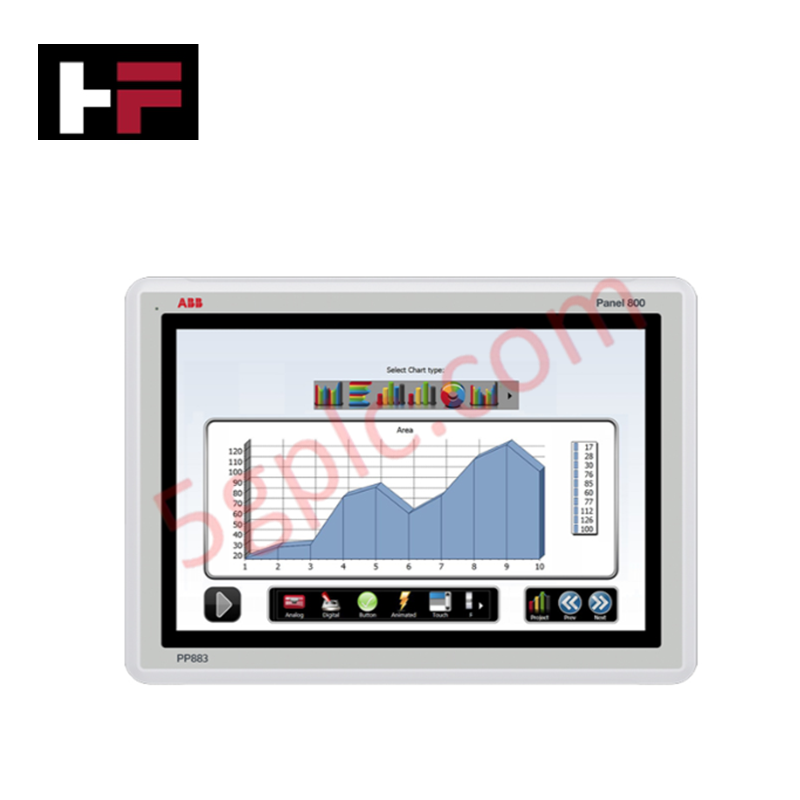
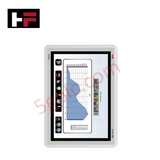
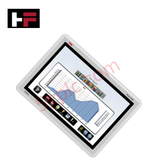
Configured for high-speed user interface control and visual data mapping in machine architectures, the ABB 3BSE092979R1 (PP883 Touchscreen Panel) provides direct physical/electrical execution.
Hardware Specifications
| Parameter | Specification |
|---|---|
| Model | 3BSE092979R1 |
| Brand | ABB |
| Origin | Sweden / Europe standard sourcing |
| Weight | 2.6 kg |
| Dimensions | 340 mm x 242 mm x 57 mm |
| Operating Temp | -10 to +60 deg C |
| Power Consumption | 24 VDC (18 to 32 VDC operating range) |
| Display Size | 12.1 inches |
| Display Type | TFT / LED |
| Resolution | 1280 x 800 pixels (16:10 aspect ratio) |
| Brightness | 400 cd/m2 |
| Processor | ARM9 (1 GHz) |
| Main Memory | 1 GB |
| External Storage | 2 GB SSD (1.5 GB available flash allocation) |
| Environmental | RoHS compliant |
Profinet / EtherNet/IP Deterministic Networks and I/O Density Scaling
The ABB 3BSE092979R1 interfaces directly with complex automation rings, deploying its 1 GHz ARM9 core to manage industrial data traffic variations. The hardware interface links seamlessly with Profinet / EtherNet/IP deterministic networks to lock communication synchronization cycles into steady intervals, filtering noise or transmission lag from the data string. When managing localized adjustments in I/O density scaling, the panel processes field bus multi-protocol datasets across internal partitions without straining physical processor cycles. This separation mitigates backplane load limits, confirming overall firmware flash compatibility remains stable under modified field mapping profiles.
Frequently Asked Questions
Q: What are the installation restrictions concerning power wire hot-swapping for this touch panel?
A: Hot-swapping the principal 24 VDC terminal plug while the system is energized is strictly prohibited. Terminal disconnects during live operation generate arcs that degrade contact plating and risk triggering internal memory storage board faults.
Q: How does the internal storage handle cyclic logging data without causing partition depletion?
A: The hardware divides the 2 GB integrated SSD into isolated zones, keeping 1.5 GB free for user application storage. Project runtimes must utilize circular registers to prevent high-frequency logging from exhausting write endurance layers.
Field Installation Guidelines
- Verify enclosure cutout geometry matches the physical 340 mm x 242 mm boundaries exactly to minimize mechanical stresses on the display frame.
- Confirm the front perimeter seal sits flat against the enclosure facing before tightening the retention clamps to preserve environmental rating metrics.
- Fasten all included mounting screws to standard torque tolerances, adopting a sequential star sequence to uniform seal compression.
- Ground the panel assembly by connecting a heavy-gauge copper strap from the grounding stud directly to the local chassis earth system to prevent electrical noise on the signal lines.
Additional Information
- 100% Genuine Parts: All products are original and authentic, ensuring reliable industrial performance.
- 30-Day Refund Guarantee: Return any in-stock item within 30 days in original, unopened packaging for a full refund (excluding shipping and fees).
- 12-Month Warranty: Covers defects in materials or workmanship; excludes misuse, normal wear, or unauthorized modifications.
- Worldwide Shipping: We ship via USPS, UPS, FedEx, and DHL. Delivery times vary by country and may be subject to customs or import fees.
- Support & Contact: Technical and warranty assistance is available anytime. Contact us here: Contact.
- Purchase Guidance: Check product specifications and compatibility carefully before ordering to ensure proper application.






Tech & Buying Guide

Redefining Control Systems: The Rise of Flexible I/O Modules in Industrial Automation
Conventional input-output architectures often limit engineering agility and inflate long-term inventory costs. Today, Flexible Input/Output Modules (FIOM) are transforming how control system engineers design, commission, and maintain automation infrastructure. By allowing individual channel software configuration, FIOM technology bridges the gap between rigid hardware design and dynamic plant requirements.

Understanding Modern SCADA Systems: Architecture, Communication Topologies, and Industrial Applications
Supervisory Control and Data Acquisition (SCADA) systems form the digital backbone of modern industrial automation. They collect critical field data, transmit signals across vast distances, and empower plant operators with real-time process visibility. Across modern infrastructures, SCADA solutions streamline centralized control and maintain continuous operational uptime.
Understanding OPC Servers in Modern Industrial Automation: Principles, Architecture, and Applications
In industrial automation, connecting physical hardware with high-level software remains a primary operational challenge. Factories utilize programmable logic controllers (PLCs), distributed control systems (DCS), human-machine interfaces (HMIs), and smart sensors from diverse vendors. These devices often speak different proprietary protocols. Open Platform Communications (OPC) servers solve this interoperability challenge by standardizing how data flows across factory networks.