










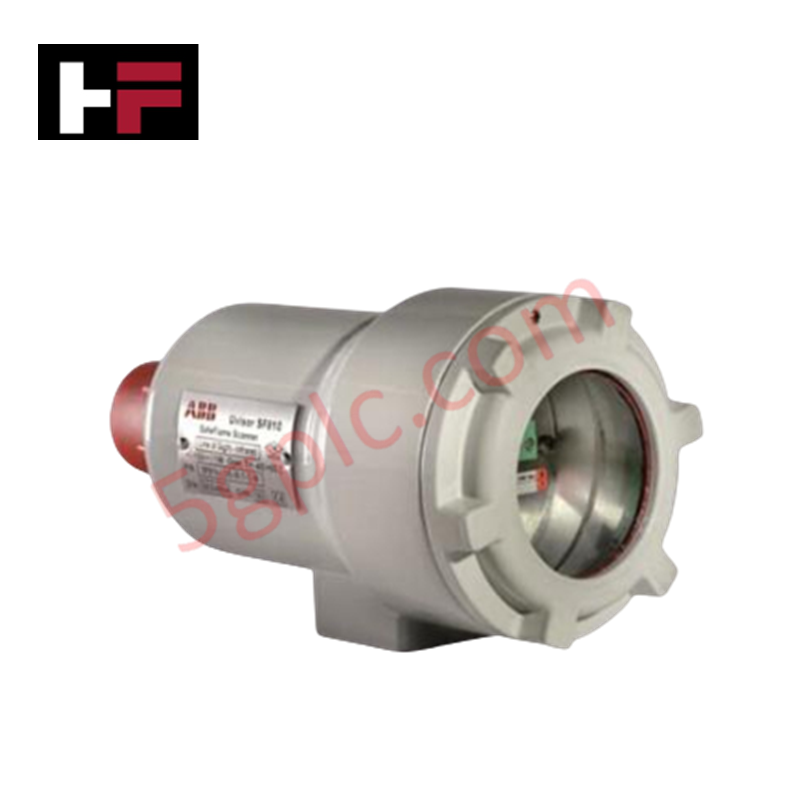


Product Details
The ABB SF810INT-LOS-UVIR-T-L, also cataloged as the SF810INT-LOS-UVIR-T-L Multi-Fuel Flame Scanner, operates as a dedicated hardware component for multi-fuel flame detection and optical signal evaluation within Symphony Plus Combustion Instruments network platforms. The scanner utilizes dual UV/IR photodiodes to sense spectral emissions across natural gas, heavy oil, pulverized coal, and sulfur gas combustion processes, executing trip signals through configurable flame failure response windows.
Hardware Specifications
| Parameter | Specification |
|---|---|
| Model | SF810INT-LOS-UVIR-T-L |
| Brand | ABB |
| Operating Temp | Up to +350 deg C (for UVIR fiber optic cables) |
| Power Consumption | 3.6 W typical, 4 W max |
| Power Supply | 24 VDC (18 to 29 VDC operating range) |
| Sensor Technology | Dual sensor UV/IR (UV peak at 280 nm, IR peak at 920 nm) |
| Output & Interfaces | Isolated 4-20 mA output, 2x RS-485 (Profibus/Modbus), 2x Opto-coupled inputs |
| Purge Air Requirement | 115 l/min purge air flow for LOS lens cleaning |
| Protection Class | IP66 / IP67 |
Backplane Bus Communication Velocity & I/O Density Scaling
The SF810INT-LOS-UVIR-T-L flame scanner integrates into system automation architectures via dual redundant RS-485 interfaces supporting Modbus and Profibus communications, maintaining high backplane bus communication velocity and deterministic telemetry transmission. Direct parameter switching via two opto-coupled digital inputs allows fast configuration matching across multiple fuel profiles. Full firmware flash compatibility enables dynamic diagnostic monitoring and remote sensitivity tuning without interrupting backplane serial data paths.
Frequently Asked Questions
Q: What is the required purge air volume for lens cleaning on the LOS configuration?
A: Line-of-Sight (LOS) scanner models require a constant clean air flow of 115 l/min directed across the optical lens assembly to prevent debris accumulation.
Q: How is the Flame Failure Response Time (FFRT) adjusted on the scanner?
A: FFRT parameters can be configured through the software communications interface within a selectable window ranging from 0.2 to 4.0 seconds.
Q: Does the 4-20 mA analog output feature electrical isolation?
A: Yes. The 4-20 mA analog output channel provides built-in galvanic isolation to protect control system receivers against ground loop interference.
Field Installation Guidelines
Observe the following field installation guidelines during mounting and wiring:
- Sight Pipe Alignment: Mount the line-of-sight scanner assembly onto the sight pipe flange, ensuring the optical axis directly targets the primary combustion zone.
- Purge Air Connection: Connect a clean, dry, instrument-grade air supply line delivering 115 l/min to the purge air port prior to lighting the burner.
- Cable Shielding: Wire the redundant RS-485 serial communication lines and 4-20 mA signal cables using individually shielded twisted pairs, terminating the shield braid at the control panel earth bar.
- Supply Power Connection: Connect the 24 VDC power feed (18 to 29 VDC range) to the designated terminal block, ensuring proper terminal polarity before energizing the device.
Additional Information
- 100% Genuine Parts: All products are original and authentic, ensuring reliable industrial performance.
- 30-Day Refund Guarantee: Return any in-stock item within 30 days in original, unopened packaging for a full refund (excluding shipping and fees).
- 12-Month Warranty: Covers defects in materials or workmanship; excludes misuse, normal wear, or unauthorized modifications.
- Worldwide Shipping: We ship via USPS, UPS, FedEx, and DHL. Delivery times vary by country and may be subject to customs or import fees.
- Support & Contact: Technical and warranty assistance is available anytime. Contact us here: Contact.
- Purchase Guidance: Check product specifications and compatibility carefully before ordering to ensure proper application.




Tech & Buying Guide

Top 5 Operational Advantages of HMIs in Modern Factory Automation

Importance of Safety Barriers in PLC and DCS Control Systems
