










Product Details
Product Overview
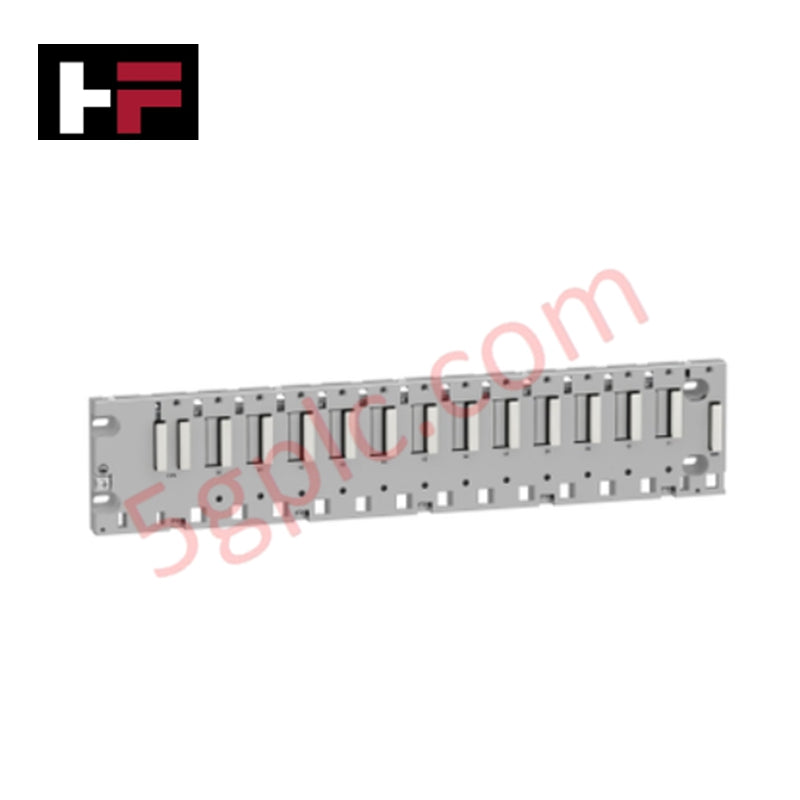
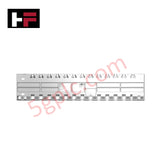
The BMXXBP1200 serves as the structural and data foundation for the Schneider Electric Modicon X80 I/O platform. This 12-slot rack facilitates high-speed communication between BMXP34 processors, power supply modules, and specific application modules. As a 100% Brand New and Original component, it ensures bus stability and power distribution integrity for complex PAC (Programmable Automation Controller) architectures.
Technical Specifications
The following table outlines the critical physical and electrical parameters for integration:
| Feature | Specification |
| Number of Slots | 12 Bus X Slots |
| Compatible Processors | Modicon M340 (BMXP34) |
| Power Consumption | 0.17 W (Ultra-low thermal footprint) |
| Electrical Interface | 1 Connector (XBE) for expansion modules |
| Operating Temperature | 32…140 °F (0…60 °C) |
| Protection Rating | IP20 |
| Vibration/Shock Resistance | Compliant with EN/IEC 61131-2 |
| Weight | 2.80 lb (1.27 kg) |
Engineering Advantages
-
High-Density Scalability: The 12-slot format minimizes cabinet footprint while maximizing I/O capacity. Engineers can consolidate extensive automation loops into a single rack, reducing the need for multiple expansion cables.
-
Reliable Panel Integration: The unit supports versatile mounting via four M4, M5, or M6 screws directly to a panel or mounting plate. This robust fixing mode eliminates vibration-induced signal loss in heavy industrial environments.
-
Electromagnetic Resilience: The BMXXBP1200 meets EN/IEC 61000-6-5 and EN/IEC 61850-3 standards. It maintains data integrity in locations with high electrical noise, such as power substations or motor control centers.
-
Global Compliance: Full certification including UL, CSA, RCM, and Merchant Navy (IACS E10) ensures this backplane meets the safety and maritime standards required for international deployment.
FAQs
-
Does the BMXXBP1200 support Ethernet backplane communication?
No, the BMXXBP1200 features a Bus X backplane. If your application requires Ethernet backplane capabilities (Ethernet + Bus X), you should utilize the BMXXBP1200H or the BMXEBP series.
-
What power supplies are compatible with this rack?
This backplane accepts the full range of BMXCPS power supply modules. Ensure you calculate the total current consumption of your 12 modules to select the appropriate power supply (e.g., BMXCPS2000 or BMXCPS3500).
-
Can I expand the system beyond these 12 slots?
Yes. The integrated XBE expansion connector allows you to link multiple racks using BMXXBE1000 expansion modules and interconnecting cables.
-
Is this product supplied in original factory packaging?
We guarantee this is a 100% Brand New Schneider Electric product in its original box with all factory seals intact, ensuring full compliance with E-E-A-T reliability standards.
Additional Information
- 100% Genuine Parts: All products are original and authentic, ensuring reliable industrial performance.
- 30-Day Refund Guarantee: Return any in-stock item within 30 days in original, unopened packaging for a full refund (excluding shipping and fees).
- 12-Month Warranty: Covers defects in materials or workmanship; excludes misuse, normal wear, or unauthorized modifications.
- Worldwide Shipping: We ship via USPS, UPS, FedEx, and DHL. Delivery times vary by country and may be subject to customs or import fees.
- Support & Contact: Technical and warranty assistance is available anytime. Contact us here: Contact.
- Purchase Guidance: Check product specifications and compatibility carefully before ordering to ensure proper application.


Tech & Buying Guide

Demystifying the DDE Protocol in Legacy Industrial Automation Systems
Modern control systems rely heavily on seamless interprocess communication to exchange operational data between software programs. Microsoft first introduced the Dynamic Data Exchange (DDE) protocol in 1987 to enable real-time data sharing. In factory automation, DDE served as an early bridge between control software and Windows desktop applications. Therefore, understanding DDE mechanics provides crucial insights into how legacy industrial networks established software-level connectivity.

Demystifying CPU Communication Ports in Siemens PLC Architectures
Industrial automation relies heavily on robust data exchange between devices. Without seamless connectivity, field instruments, network switches, human-machine interfaces, and programmable logic controllers cannot coordinate effectively. Therefore, understanding the various CPU communication ports available in Siemens hardware ensures efficient factory automation design and seamless system integration.

Mastering the Siemens PLC Scan Cycle: How the CPU Executes Automation Programs
Industrial automation relies heavily on programmable logic controllers (PLCs) to manage complex manufacturing processes. Many engineers dive straight into programming without mastering the underlying architecture. However, understanding how a PLC CPU executes a program ensures reliable system design. Therefore, mastering the scan cycle optimizes both performance and troubleshooting in modern control systems.