










Product Details
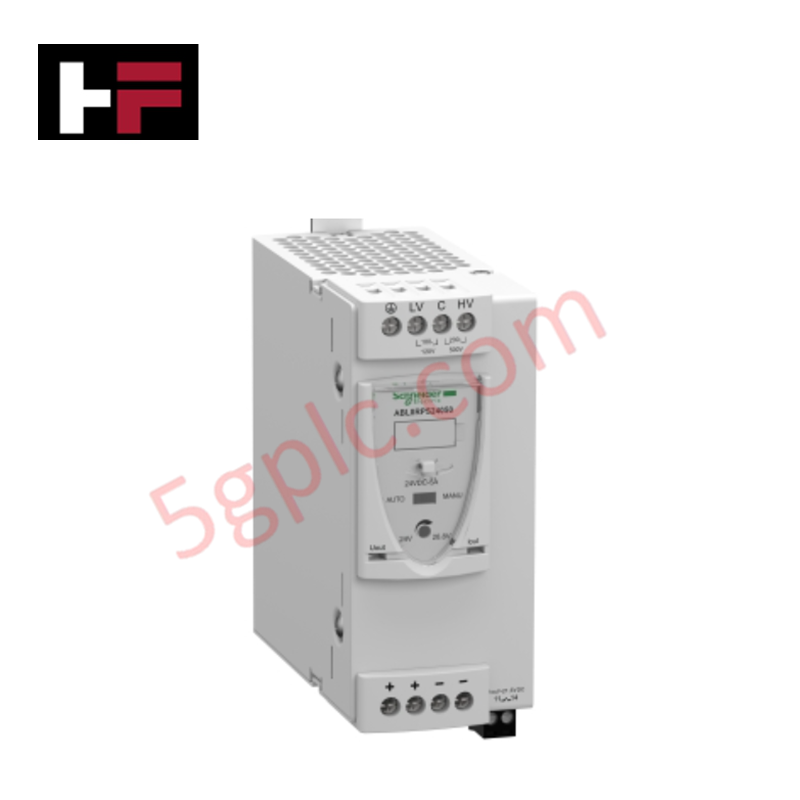
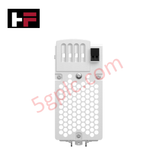
The Schneider Electric ABL8RPS24050, also cataloged as the ABL8RPS24050 Regulated Switch Mode Power Supply, operates as a dedicated hardware component for continuous direct current voltage regulation and short-circuit protection within Modicon Power Supply platforms.
Hardware Specifications
| Parameter | Specification |
|---|---|
| Model | ABL8RPS24050 |
| Brand | Schneider Electric |
| Origin | France |
| Weight | 0.7 kg |
| Dimensions | 143 mm x 56 mm x 125 mm (H x W x D) |
| Operating Temp | -25 to 50 deg C (without derating), 50 to 60 deg C (with derating) |
| Power Consumption | 15.5 W (Power Dissipation) |
| Output Voltage | 24 VDC (Adjustable 24...28.8 VDC) |
| Output Current | 5 A |
| Rated Power | 120 W |
| Nominal Input Voltage | 100...120 VAC single phase (N-L1), 200...500 VAC phase-to-phase (L1-L2) |
| Input Voltage Limits | 85...132 VAC, 170...550 VAC |
| Inrush Current | 30 A |
| Efficiency | 87 % |
| Temporary Boost | 1.5 x In (for 4 s) |
| Dielectric Strength | 4000 V (Input to Output), 3500 V (Input to Ground), 500 V (Output to Ground) |
| Protection Rating | IP20 conforming to IEC 60529 |
| Mounting Support | 35 x 7.5 mm or 35 x 15 mm symmetrical DIN rail |
Industrial Control & Deterministic Backplane Characteristics
The unit integrates internal firmware flash compatibility and filtering mechanisms aligned with high-density backplane bus communication velocity specifications across Modicon system architecture. Designed to sustain stable power delivery across distributed I/O density scaling racks and EtherNet/IP deterministic networks, the power stage features integrated Power Factor Correction conforming to IEC 61000-3-2. Low frequency harmonic current suppression maintains clean input power quality, preventing ripple noise interference from perturbing sensitive backplane bus communication lines and digital logic modules.
Frequently Asked Questions
Q: How does the power supply handle temporary overcurrent conditions during inductive load startup?
A: The module provides a permissible temporary current boost of 1.5 times the nominal rated current (7.5 A output) for up to 4 s before entering thermal or overcurrent protection state.
Q: What are the thermal derating constraints for mounting orientation?
A: The rated output of 5 A is fully available without derating between -25 deg C and 50 deg C in vertical mounting position A at altitudes up to 2000 m. Operating between 50 deg C and 60 deg C requires application of the thermal derating factor.
Field Installation Guidelines
Mount the module strictly in the vertical operating position on a 35 x 7.5 mm or 35 x 15 mm symmetrical DIN rail to ensure adequate natural thermal convection across the heat dissipation fins. Maintain minimum clearance above and below the unit for unobstructed airflow.
Wiring connections must follow terminal assignments: execute 3-wire input wiring (L1-L2 or N-L1 plus dedicated earth ground) using 0.5 to 4 mm2 (22 AWG to 12 AWG) copper conductors torque-tightened to screw terminals. Ensure output connections and output ground connection lines use separate rated wiring up to 4 mm2. Diagnostic relay contacts must be connected via the removable screw terminal block (2 x 2.5 mm2 maximum). Verify that input ground terminal impedance meets local electrical code requirements to guarantee proper SELV isolation performance and 3500 V dielectric insulation strength.
Additional Information
- 100% Genuine Parts: All products are original and authentic, ensuring reliable industrial performance.
- 30-Day Refund Guarantee: Return any in-stock item within 30 days in original, unopened packaging for a full refund (excluding shipping and fees).
- 12-Month Warranty: Covers defects in materials or workmanship; excludes misuse, normal wear, or unauthorized modifications.
- Worldwide Shipping: We ship via USPS, UPS, FedEx, and DHL. Delivery times vary by country and may be subject to customs or import fees.
- Support & Contact: Technical and warranty assistance is available anytime. Contact us here: Contact.
- Purchase Guidance: Check product specifications and compatibility carefully before ordering to ensure proper application.


Tech & Buying Guide

Demystifying the DDE Protocol in Legacy Industrial Automation Systems
Modern control systems rely heavily on seamless interprocess communication to exchange operational data between software programs. Microsoft first introduced the Dynamic Data Exchange (DDE) protocol in 1987 to enable real-time data sharing. In factory automation, DDE served as an early bridge between control software and Windows desktop applications. Therefore, understanding DDE mechanics provides crucial insights into how legacy industrial networks established software-level connectivity.

Demystifying CPU Communication Ports in Siemens PLC Architectures
Industrial automation relies heavily on robust data exchange between devices. Without seamless connectivity, field instruments, network switches, human-machine interfaces, and programmable logic controllers cannot coordinate effectively. Therefore, understanding the various CPU communication ports available in Siemens hardware ensures efficient factory automation design and seamless system integration.

Mastering the Siemens PLC Scan Cycle: How the CPU Executes Automation Programs
Industrial automation relies heavily on programmable logic controllers (PLCs) to manage complex manufacturing processes. Many engineers dive straight into programming without mastering the underlying architecture. However, understanding how a PLC CPU executes a program ensures reliable system design. Therefore, mastering the scan cycle optimizes both performance and troubleshooting in modern control systems.