













Product Details
Product Overview
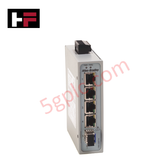
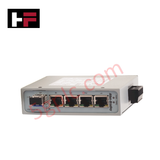
The Allen-Bradley 1783-US4T1H serves as a rugged, entry-level networking solution for industrial automation environments. This Stratix 2000 unmanaged switch expands your network capacity without requiring complex configuration. It bridges the gap between standard copper-based devices and long-distance fiber optic links, ensuring seamless data flow across the factory floor. We provide this unit as 10/100% Brand New in original packaging to guarantee maximum field reliability.
Technical Specifications
This compact module integrates five physical ports to handle diverse industrial networking requirements:
| Feature | Specification |
| Total Port Count | 5 Ports |
| Copper Ports | 4 x RJ45 (10/100 Mbps) |
| Fiber Ports | 1 x Single-Mode Fiber Port |
| Network Type | Fast Ethernet |
| SFP Slots | 0 (Fixed configuration) |
| Combo Ports | 0 |
| Enclosure | IP20 Rated |
| Input Voltage | 12-48V DC / 18-30V AC |
Engineering Advantages
The 1783-US4T1H solves specific infrastructure challenges encountered in modern manufacturing:
-
Extended Distance Connectivity: The integrated single-mode fiber port allows you to connect remote cabinets located kilometers away, surpassing the 100-meter limitation of standard copper cabling.
-
Plug-and-Play Integration: This switch requires zero software configuration. You simply mount it to the DIN rail, connect your devices, and power it up. This eliminates commissioning time and reduces the risk of human error in network settings.
-
Compact Footprint: The slim design optimizes cabinet space. It fits easily into crowded control panels where rail real estate remains at a premium.
-
High Interference Immunity: By utilizing fiber optics for the uplink, the switch eliminates electromagnetic interference (EMI) and ground loops often caused by heavy motor loads and high-voltage equipment.
FAQs
Is the 1783-US4T1H compatible with older Stratix 2000 models?
Yes. This unit functions as a direct replacement or expansion for existing 1783 series unmanaged networks. It maintains full backward compatibility with standard 10/100 Mbps Ethernet devices.
Does this switch require a managed firmware update before installation?
No. As an unmanaged switch, the 1783-US4T1H operates purely on hardware logic. It does not carry firmware that requires user-level updates or IP address assignments.
How does single-mode fiber benefit my installation compared to multi-mode?
Single-mode fiber supports significantly longer transmission distances and offers higher bandwidth consistency over miles of cabling. Use this model specifically when your network backbone spans across different buildings or large-scale facility sections.
Is this unit shipped in its original Allen-Bradley packaging?
We guarantee that every 1783-US4T1H unit is 100% Brand New, original, and remains in its factory-sealed industrial packaging to ensure it meets all manufacturer specifications.
Additional Information
- 100% Genuine Parts: All products are original and authentic, ensuring reliable industrial performance.
- 30-Day Refund Guarantee: Return any in-stock item within 30 days in original, unopened packaging for a full refund (excluding shipping and fees).
- 12-Month Warranty: Covers defects in materials or workmanship; excludes misuse, normal wear, or unauthorized modifications.
- Worldwide Shipping: We ship via USPS, UPS, FedEx, and DHL. Delivery times vary by country and may be subject to customs or import fees.
- Support & Contact: Technical and warranty assistance is available anytime. Contact us here: Contact.
- Purchase Guidance: Check product specifications and compatibility carefully before ordering to ensure proper application.
Tech & Buying Guide

Spatial Computing in Industrial Automation: Elevating PLC and DCS Operations with AR and VR
Industry 4.0 integrates digital intelligence into field operations, transforming factory automation landscapes worldwide. Spatial technologies—specifically Augmented Reality (AR) and Virtual Reality (VR)—redefine how engineers interact with industrial control systems. By bridging computer-generated CAD models with real-time operational technology (OT) data, immersive displays enable intuitive monitoring, rapid diagnostics, and safer maintenance across complex processing facilities.

Master Acceptance Testing: Understanding FAT and SAT in Industrial Control Systems
Factory Acceptance Testing (FAT) and Site Acceptance Testing (SAT) serve as critical quality assurance gateways in complex industrial control systems. Both procedures verify that programmable logic controllers (PLCs), distributed control systems (DCS), and associated field devices meet strict functional specifications. However, executing these tests effectively requires clear delineation between off-site staging and final field commissioning.

Industrial Networking Essentials: Demystifying Hubs, Switches, and Routers in Control Systems
Industrial automation relies heavily on robust networking infrastructure to connect programmable logic controllers (PLCs), distributed control systems (DCS), and human-machine interfaces (HMIs). Modern factory automation environments generate vast amounts of real-time operational data across deterministic networks. Understanding the structural differences between hubs, switches, and routers ensures optimal traffic segmentation, minimizes latency, and maintains high network availability.