












Product Details
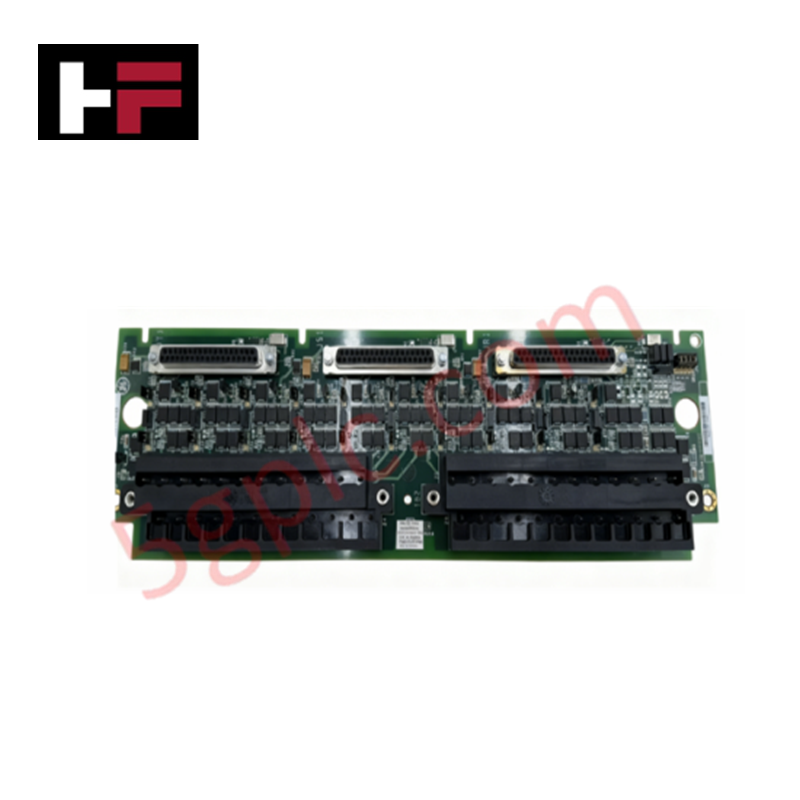
Configured for analog signal conditioning and distribution in Mark VI turbine control architectures, the GE IS200TBAIH1C (IS200TBAIH1C Analog Input Terminal Board) provides direct physical and electrical execution of multi-channel sensor input routing and analog output regulation.
Hardware Specifications
| Parameter | Specification |
|---|---|
| Model | IS200TBAIH1C |
| Brand | General Electric |
| Origin | USA |
| Weight | Standard terminal board assembly |
| Dimensions | Mark VI standard form factor |
| Operating Temp | Industrial rated range |
| Power Consumption | System-bus dependent |
| Analog Inputs | 10 (2-wire, 3-wire, 4-wire, external power) |
| Analog Outputs | 2 (0-20 mA or 0-200 mA configurable) |
| Connectivity | 3 x DC-37 pin connectors |
Profinet / EtherNet/IP Deterministic Networks
The IS200TBAIH1C integrates into the Mark VI control platform as a primary interface for analog instrumentation. The board supports backplane bus communication velocity by utilizing high-density DC-37 connectors for interfacing with I/O processors in both simplex and Triple Modular Redundant (TMR) configurations. Firmware flash compatibility is handled by the associated I/O packs to ensure precise signal scaling and I/O density scaling. The input/output circuits incorporate noise suppression hardware to mitigate surge and high-frequency interference, ensuring signal integrity. In TMR applications, the board utilizes internal measuring shunts to combine output driver signals, enabling the controller to regulate total current to the specific setpoint required for turbine control.
Frequently Asked Questions
Q: Is the IS200TBAIH1C board hot-swappable while the turbine control system is active?
A: No. Terminal board replacement requires the system to be in a non-operational state. Removing the board while energized will cause communication loss with I/O processors and potential damage to the DC-37 pin interface.
Q: Can the board be configured for mixed simplex and TMR operation?
A: The board supports TMR via all three connectors or simplex on one connector (UR1). Configuration must be consistent with the backplane I/O processor setup to prevent signal routing errors.
Field Installation Guidelines
- Mounting: Secure the terminal board to the mounting plate within the control cabinet. Ensure all chassis grounds are established to maintain the efficacy of the integrated noise suppression circuitry.
- Wiring: Terminate field inputs to the terminal blocks. Ensure that external power sources for transmitters are properly isolated and fused as per the system electrical schematic.
- Connectivity: Connect the DC-37 cables to the R, S, and T interface ports based on the system architecture (simplex or TMR). Verify that connectors are fully seated and locking mechanisms are engaged.
- Environment: Verify the cabinet ambient temperature is within the industrial operating range. Ensure adequate ventilation to prevent thermal drift of the precision measuring shunts.
- Verification: Prior to startup, perform a loop check for each of the 10 analog inputs. Use the controller diagnostic interface to confirm that input signals match field transmitter outputs and that output mA values are within configured setpoint limits.
Additional Information
- 100% Genuine Parts: All products are original and authentic, ensuring reliable industrial performance.
- 30-Day Refund Guarantee: Return any in-stock item within 30 days in original, unopened packaging for a full refund (excluding shipping and fees).
- 12-Month Warranty: Covers defects in materials or workmanship; excludes misuse, normal wear, or unauthorized modifications.
- Worldwide Shipping: We ship via USPS, UPS, FedEx, and DHL. Delivery times vary by country and may be subject to customs or import fees.
- Support & Contact: Technical and warranty assistance is available anytime. Contact us here: Contact.
- Purchase Guidance: Check product specifications and compatibility carefully before ordering to ensure proper application.



Tech & Buying Guide

Hub vs Switch vs Router in Industrial Automation Architecture
Modern factory automation relies on reliable industrial networking infrastructure to exchange real-time field data across operational technology systems. Engineers often encounter networking hardware like hubs, switches, and routers when integrating Programmable Logic Controllers, Distributed Control Systems, and SCADA monitoring nodes. Although these devices share physical ports, they operate at different layers of the Open Systems Interconnection reference model and deliver distinct traffic management capabilities.

Marshalling Cabinet Preventive Maintenance: Essential Healthiness Checks for PLC, DCS, and ESD Systems
Marshalling cabinets serve as the vital interface between field instrumentation and control room electronics in modern process facilities. Regular preventive maintenance of these cabinets ensures signal integrity across programmable logic controllers (PLCs), distributed control systems (DCS), and emergency shutdown (ESD) networks. System technicians must execute structured inspection protocols to mitigate environmental risks, identify loose wiring, and maintain continuous operational readiness.

Spatial Computing in Industrial Automation: Elevating PLC and DCS Operations with AR and VR
Industry 4.0 integrates digital intelligence into field operations, transforming factory automation landscapes worldwide. Spatial technologies—specifically Augmented Reality (AR) and Virtual Reality (VR)—redefine how engineers interact with industrial control systems. By bridging computer-generated CAD models with real-time operational technology (OT) data, immersive displays enable intuitive monitoring, rapid diagnostics, and safer maintenance across complex processing facilities.