












Product Details
Product Description:
Overview:
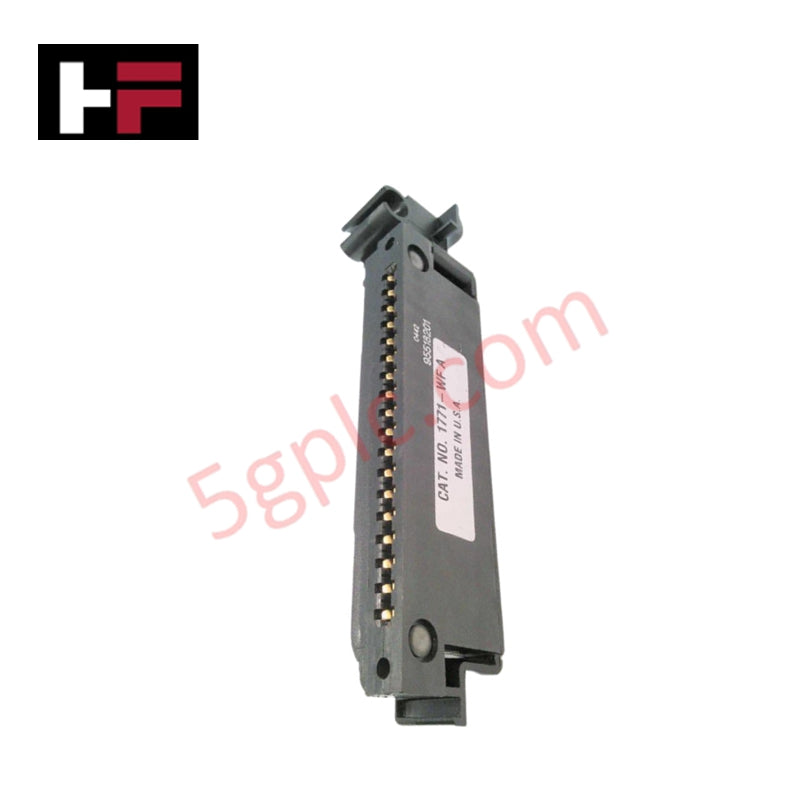
The 1771-WF from Allen Bradley is a high-quality field wiring arm designed for seamless integration with PLC-5 systems. It ensures efficient connections between I/O modules and field wiring, particularly in applications where low resistance is critical. With its durable design and gold-plated contacts, the 1771-WF guarantees reliable signal transmission in demanding environments. This model is part of the Allen Bradley PLC series and is equipped with all the features required for stable and efficient signal management.
Key Technical Specifications:
-
Part Number: 1771-WF
-
Manufacturer: Rockwell Automation
-
Module Type: Field Wiring Arm
-
Max Number of I/O Points: Supports up to 8 I/O points for flexible and efficient system integration.
-
Number of Terminals: 18 terminals with gold contact plating for enhanced conductivity and durability.
-
Coating: Conformal coating for environmental protection, ensuring reliable operation in harsh conditions.
-
Screw Torque: 7-9 lb*in for secure terminal connections.
-
Dimensions:
-
Size: 4.5 x 12.4 x 6.3 inches (115 x 317 x 160 mm)
-
Weight: 0.2 lbs (0.1 kg), lightweight and easy to install.
-
Max Fuse Size: Not applicable for this model.
-
Required External Power: No external power is required, simplifying the installation process and saving on operational costs.
Performance Characteristics:
-
Typical AC Signal Delay (Off): 29 ms (+/- 8 ms), ensuring minimal signal loss and precise timing.
-
Typical DC Signal Delay (Off): 30 ms (+/- 7 ms), providing accurate DC signal transmission with minimal delay.
Typical Applications:
-
Low Resistance Applications: Specifically designed for applications where low resistance is a critical factor, ensuring smooth signal transmission with minimal interference.
Wiring and Compatibility:
-
Compatible Wiring Arm: Can be paired with the 1771-WN wiring arm for enhanced versatility and connectivity.
-
Wire Connection: Accepts AWG 14 wire via clamp or spade lug, providing flexible installation options for a variety of systems.
FAQ
Q1: What is the maximum number of I/O points supported by the 1771-WF?
A1: The 1771-WF supports up to 8 I/O points, which is ideal for smaller-scale systems or those requiring limited I/O connections.
Q2: Does the 1771-WF require external power?
A2: No, the 1771-WF does not require any external power, simplifying installation and making it easier to integrate into existing systems.
Q3: What are the typical signal delays for AC and DC signals?
A3:
-
AC signal delay: 29 ms (+/- 8 ms)
-
DC signal delay: 30 ms (+/- 7 ms)
Q4: Is the 1771-WF compatible with other wiring arms?
A4: Yes, the 1771-WF is compatible with the 1771-WN wiring arm, allowing for additional flexibility when integrating into your system.
Additional Information
- 100% Genuine Parts: All products are original and authentic, ensuring reliable industrial performance.
- 30-Day Refund Guarantee: Return any in-stock item within 30 days in original, unopened packaging for a full refund (excluding shipping and fees).
- 12-Month Warranty: Covers defects in materials or workmanship; excludes misuse, normal wear, or unauthorized modifications.
- Worldwide Shipping: We ship via USPS, UPS, FedEx, and DHL. Delivery times vary by country and may be subject to customs or import fees.
- Support & Contact: Technical and warranty assistance is available anytime. Contact us here: Contact.
- Purchase Guidance: Check product specifications and compatibility carefully before ordering to ensure proper application.
Tech & Buying Guide

Demystifying the DDE Protocol in Legacy Industrial Automation Systems
Modern control systems rely heavily on seamless interprocess communication to exchange operational data between software programs. Microsoft first introduced the Dynamic Data Exchange (DDE) protocol in 1987 to enable real-time data sharing. In factory automation, DDE served as an early bridge between control software and Windows desktop applications. Therefore, understanding DDE mechanics provides crucial insights into how legacy industrial networks established software-level connectivity.

Demystifying CPU Communication Ports in Siemens PLC Architectures
Industrial automation relies heavily on robust data exchange between devices. Without seamless connectivity, field instruments, network switches, human-machine interfaces, and programmable logic controllers cannot coordinate effectively. Therefore, understanding the various CPU communication ports available in Siemens hardware ensures efficient factory automation design and seamless system integration.

Mastering the Siemens PLC Scan Cycle: How the CPU Executes Automation Programs
Industrial automation relies heavily on programmable logic controllers (PLCs) to manage complex manufacturing processes. Many engineers dive straight into programming without mastering the underlying architecture. However, understanding how a PLC CPU executes a program ensures reliable system design. Therefore, mastering the scan cycle optimizes both performance and troubleshooting in modern control systems.