












Product Details
Product Overview
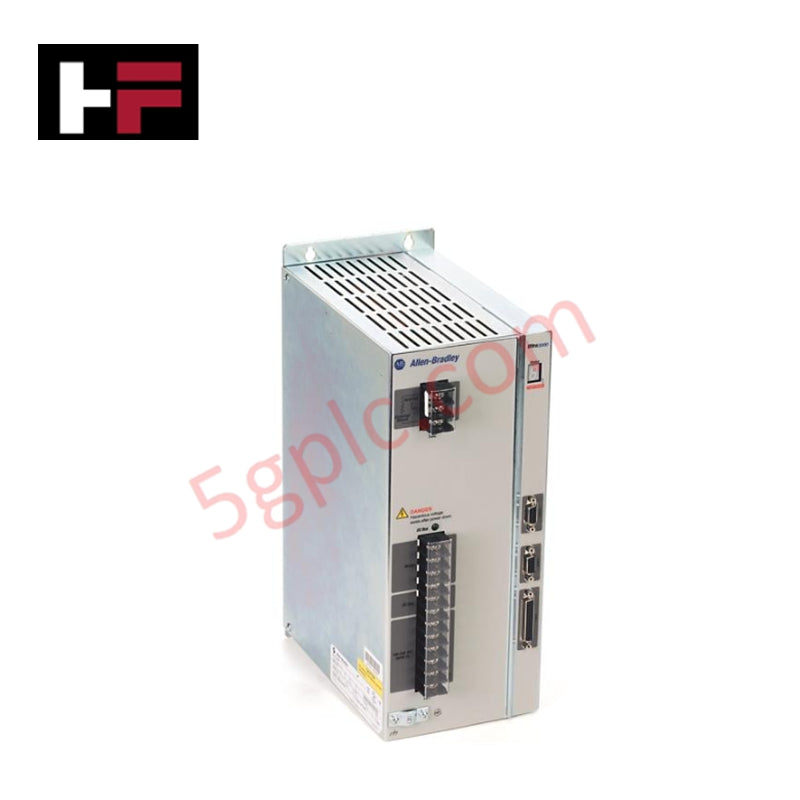
The Allen-Bradley 2098-DSD-150-SE provides high-performance motion control for demanding industrial applications. This Ultra3000 servo drive delivers 65 Amps of continuous current and 150 Amps of intermittent peak current to handle high-inertia loads. It operates on a three-phase 230-480V AC input and integrates SERCOS interface technology for precise synchronization with Logix controllers. The unit features an internal shunt and auxiliary power supply, simplifying system wiring. We supply this item as a 100% Brand New, factory-sealed unit.
Technical Specifications
| Parameter | Specification |
|---|---|
| Manufacturer | Allen-Bradley (Rockwell Automation) |
| Product Line | Ultra 3000 Drives |
| Input Voltage | 230-480V AC (Three Phase) |
| Input Frequency | 47-63 Hz |
| Continuous Output | 65 Amps (0-peak) |
| Intermittent Output | 150 Amps (0-peak) |
| Nominal Input Current | 46 Amps RMS |
| Bus Capacitance | 7520 µF |
| Internal Shunt | 9.1 Ohms |
| Weight | 31.00 lbs (14.06 kg) |
Engineering Advantages
High-Power Motion Control
The 2098-DSD-150-SE drives large servo motors with 65A of continuous current. For dynamic moves requiring rapid acceleration, the drive supplies up to 150A intermittently. This power reserve ensures your machine maintains path accuracy and cycle times even under heavy cutting loads or high-speed indexing.
Integrated SERCOS Interface
This drive connects directly to ControlLogix or CompactLogix controllers via the SERCOS fiber optic network. This digital interface eliminates electrical noise interference common in analog systems. It allows for precise coordination of multi-axis motion, enabling complex camming and gearing applications with microsecond-level synchronization.
Built-In Power Management
The unit includes an internal shunt resistor (9.1 Ohms) that dissipates regenerative energy during deceleration. This feature prevents bus overvoltage faults (triggered at 452V DC) without requiring external braking resist. Additionally, the auxiliary power supply keeps the logic circuits active while the main bus is disabled, facilitating faster startup and safer troubleshooting.
FAQs
Q: What input voltage does the 2098-DSD-150-SE require?
A: The drive requires a three-phase AC input ranging from 230V to 480V RMS. It automatically adapts to the supplied voltage within this range, making it suitable for various industrial power grids.
Q: Can I use this drive for single-axis or multi-axis applications?
A: Yes. The SERCOS interface supports daisy-chaining multiple drives on a single fiber ring. You can use the 2098-DSD-150-SE as part of a coordinated multi-axis system or as a standalone high-power axis.
Q: Does this drive have an internal shunt?
A: Yes. The 2098-DSD-150-SE features a 9.1 Ohm internal shunt. This handles moderate regenerative energy. For applications with extremely high inertia or vertical loads, you may still need to verify if an external shunt is required based on your specific duty cycle.
Q: What is the difference between continuous and intermittent current?
A: Continuous current (65A) is the amount the drive can supply indefinitely without overheating. Intermittent current (150A) is the peak output available for short durations (typically seconds) to accelerate loads or overcome friction.
Additional Information
- 100% Genuine Parts: All products are original and authentic, ensuring reliable industrial performance.
- 30-Day Refund Guarantee: Return any in-stock item within 30 days in original, unopened packaging for a full refund (excluding shipping and fees).
- 12-Month Warranty: Covers defects in materials or workmanship; excludes misuse, normal wear, or unauthorized modifications.
- Worldwide Shipping: We ship via USPS, UPS, FedEx, and DHL. Delivery times vary by country and may be subject to customs or import fees.
- Support & Contact: Technical and warranty assistance is available anytime. Contact us here: Contact.
- Purchase Guidance: Check product specifications and compatibility carefully before ordering to ensure proper application.
Tech & Buying Guide

Why 24V DC Power Supplies Standardize Modern Industrial Automation
Industrial control cabinets worldwide rely on 24V DC as the universal power standard for field instrumentation, sensors, and controllers. Walk into any manufacturing plant, and you will find PLCs, human-machine interfaces (HMIs), and smart actuators running on extra-low voltage DC. Standardizing on 24V DC enhances operational safety, lowers cabinet footprint, and maintains steady control performance across factory networks.

Essential Motion Control Commands: A Practical Guide for Engineers
Automation engineers often rely on precise position and speed control to drive modern factory machinery. Modern industrial systems, such as Programmable Logic Controllers (PLCs) and Distributed Control Systems (DCS), depend heavily on standardized motion instructions. Mastering these commands ensures operational safety, protects mechanical components, and optimizes cycle times across production lines.
Mastering Modern Industrial Joystick Controls in Heavy Automation
Industrial joysticks play a pivotal role in human-machine interaction across heavy material handling and mobile hydraulics. These tactile controllers translate complex operator movements into precise electrical signals for PLCs, motion controllers, and DCS networks. Consequently, selecting and installing the right joystick architecture ensures operator safety, reduces fatigue, and optimizes equipment performance.