










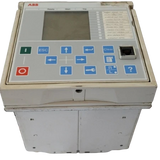

Product Details
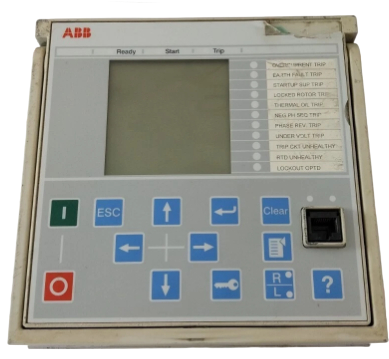
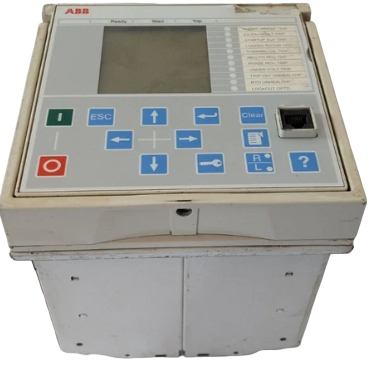
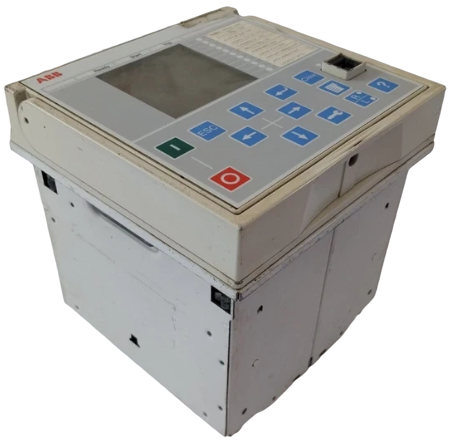
The ABB REM615 HBMCAEAGNBA1BNN1XG, also cataloged as the REM615 Motor Protection And Control Relay, operates as a dedicated hardware component for thermal monitoring, fault detection, and circuit switching within Relion 615 series platforms.
Hardware Specifications
| Parameter | Specification |
|---|---|
| Model | REM615 HBMCAEAGNBA1BNN1XG |
| Brand | ABB |
| Origin | Finland |
| Weight | Standard Relion 615 series IED enclosure weight |
| Dimensions | Compact pluggable flush-mount or rack-mount chassis |
| Operating Temp | -25 to +55 deg C |
| Power Consumption | Low-power internal auxiliary supply draw |
| Protection Capabilities | Thermal overload, start-up/stall supervision, phase reversal/unbalance, arc flash |
| Supported Protocols | IEC 61850 Ed.1/Ed.2, Modbus, DNP3, IEC 60870-5-103, Profibus DPV1 |
| Redundancy Support | PRP and HSR Ethernet network topologies |
| Time Synchronization | IEEE 1588 v2 time protocol |
| User Interface | Large LCD with single-line diagram, local HMI, web access |
Backplane Bus Communication Velocity & Network Redundancy
The REM615 HBMCAEAGNBA1BNN1XG processes current, voltage, and digital feedback inputs via localized hardware buses, optimizing backplane bus communication velocity and logic execution. Designed for high-speed network integration, the relay utilizes IEEE 1588 v2 microsecond time synchronization alongside PRP and HSR Ethernet architectures to maintain deterministic data transmission. Internal firmware flash compatibility supports configuration mapping through PCM600 engineering software, enabling simultaneous reporting over IEC 61850 GOOSE and industrial serial protocols.
Frequently Asked Questions
Q: Which communication protocols are supported natively for substation automation interfaces?
A: The relay supports IEC 61850 Edition 1 and Edition 2 (including IEC 61850-9-2 LE), Modbus, DNP3, IEC 60870-5-103, and Profibus DPV1 via adapter.
Q: How does the REM615 maintain communication availability during network failures?
A: The device incorporates Parallel Redundancy Protocol (PRP) and High-availability Seamless Redundancy (HSR) modes to eliminate network recovery delays upon path disconnection.
Q: What mechanisms protect against thermal and mechanical stress during motor startup?
A: Integrated thermal overload algorithms, motor start-up counters, load-loss supervision, and locked-rotor stall detection prevent degradation from excessive current draw.
Field Installation Guidelines
- Mount the pluggable REM615 chassis into the panel cutout, ensuring the mechanical frame latch engages securely.
- Connect chassis ground to the main switchgear earthing bus using a heavy copper conductor to shield internal electronics from high-frequency noise.
- Wire current transformer (CT) and voltage transformer (VT) secondary circuits to the rear terminal blocks, verifying correct polarity before applying load.
- Connect dual Ethernet cables to the network ports for PRP/HSR redundancy routing, ensuring minimum bend radius rules are maintained.
- Apply auxiliary power and verify relay health via the local HMI display and LED status indicators prior to closing primary breaker circuits.
Additional Information
- 100% Genuine Parts: All products are original and authentic, ensuring reliable industrial performance.
- 30-Day Refund Guarantee: Return any in-stock item within 30 days in original, unopened packaging for a full refund (excluding shipping and fees).
- 12-Month Warranty: Covers defects in materials or workmanship; excludes misuse, normal wear, or unauthorized modifications.
- Worldwide Shipping: We ship via USPS, UPS, FedEx, and DHL. Delivery times vary by country and may be subject to customs or import fees.
- Support & Contact: Technical and warranty assistance is available anytime. Contact us here: Contact.
- Purchase Guidance: Check product specifications and compatibility carefully before ordering to ensure proper application.






Tech & Buying Guide

Spatial Computing in Industrial Automation: Elevating PLC and DCS Operations with AR and VR
Industry 4.0 integrates digital intelligence into field operations, transforming factory automation landscapes worldwide. Spatial technologies—specifically Augmented Reality (AR) and Virtual Reality (VR)—redefine how engineers interact with industrial control systems. By bridging computer-generated CAD models with real-time operational technology (OT) data, immersive displays enable intuitive monitoring, rapid diagnostics, and safer maintenance across complex processing facilities.

Master Acceptance Testing: Understanding FAT and SAT in Industrial Control Systems
Factory Acceptance Testing (FAT) and Site Acceptance Testing (SAT) serve as critical quality assurance gateways in complex industrial control systems. Both procedures verify that programmable logic controllers (PLCs), distributed control systems (DCS), and associated field devices meet strict functional specifications. However, executing these tests effectively requires clear delineation between off-site staging and final field commissioning.

Industrial Networking Essentials: Demystifying Hubs, Switches, and Routers in Control Systems
Industrial automation relies heavily on robust networking infrastructure to connect programmable logic controllers (PLCs), distributed control systems (DCS), and human-machine interfaces (HMIs). Modern factory automation environments generate vast amounts of real-time operational data across deterministic networks. Understanding the structural differences between hubs, switches, and routers ensures optimal traffic segmentation, minimizes latency, and maintains high network availability.