












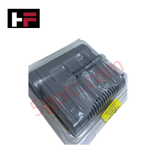

Product Details
Configured for power conversion and 24 VDC voltage distribution in Honeywell DCS and PLC environments, the Honeywell 51454460-300 (51454460-300 Power Supply Module) provides direct physical/electrical execution.
Hardware Specifications
| Parameter | Specification |
|---|---|
| Model | 51454460-300 |
| Brand | Honeywell |
| Origin | USA |
| Operating Temp | -20 to 70 deg C |
| Power Consumption | 60 W Rated Power Output |
| Input Voltage | 100-240 VAC Universal Input |
| Output Voltage | 24 VDC |
| Output Current | 2.5 A |
| Efficiency | Greater than 85% |
| Mounting Type | DIN Rail |
| Cooling | Natural air convection |
4-20 mA HART Loop Protocol & Channel-to-Channel Isolation
The 51454460-300 switching regulation architecture incorporates overvoltage, overcurrent, and short-circuit suppression networks to maintain tight output regulation under variable loads. Internal galvanic isolation shields output terminals from primary AC mains transients, preventing common-mode noise from coupling into analog I/O loops operating on the 4-20 mA HART loop protocol. Designed for high-density cabinet layouts, its low heat emission limits localized thermal drift across adjacent process control instrumentation and cold junction compensation (CJC) references.
Frequently Asked Questions
Q: Does this module require an external voltage selector for different AC inputs?
A: No, the 51454460-300 features a universal input range of 100-240 VAC and automatically adjusts to the supply voltage.
Q: What protection features are built into the 51454460-300 circuit?
A: The unit includes integrated protection against overvoltage, overcurrent, and short-circuit conditions, recovering automatically once the fault is cleared.
Q: What cooling configuration is required for mounting in high-density control panels?
A: The module relies on natural air convection cooling and requires adequate vertical clearance above and below the chassis for unimpeded airflow.
Field Installation Guidelines
- Mount the 51454460-300 securely onto a standard DIN rail inside the enclosure, keeping sufficient vertical space open for convective airflow.
- Verify that primary supply power is completely de-energized before making terminal wire connections.
- Wire the 100-240 VAC input lines and 24 VDC output connections using copper conductors rated for the load current and terminal spec.
- Connect the module chassis grounding terminal directly to the panel earth busbar using a low-impedance grounding wire.
- Apply input power and measure the 24 VDC terminal output with a calibrated multimeter before connecting downstream instrument loads.
Additional Information
- 100% Genuine Parts: All products are original and authentic, ensuring reliable industrial performance.
- 30-Day Refund Guarantee: Return any in-stock item within 30 days in original, unopened packaging for a full refund (excluding shipping and fees).
- 12-Month Warranty: Covers defects in materials or workmanship; excludes misuse, normal wear, or unauthorized modifications.
- Worldwide Shipping: We ship via USPS, UPS, FedEx, and DHL. Delivery times vary by country and may be subject to customs or import fees.
- Support & Contact: Technical and warranty assistance is available anytime. Contact us here: Contact.
- Purchase Guidance: Check product specifications and compatibility carefully before ordering to ensure proper application.


Tech & Buying Guide

FAT vs SAT in Industrial Control Systems: Key Differences and Execution Guide
Industrial control system deployment relies on strict verification protocols to guarantee operational safety, system stability, and regulatory compliance. Commissioning complex Programmable Logic Controller (PLC) racks, Distributed Control Systems (DCS), and Safety Instrumented Systems (SIS) requires two critical milestones: the Factory Acceptance Test (FAT) and the Site Acceptance Test (SAT). Both procedures validate that system automation meets design specifications, but they occur at different stages of project execution and target distinct operational risks.

Hub vs Switch vs Router in Industrial Automation Architecture
Modern factory automation relies on reliable industrial networking infrastructure to exchange real-time field data across operational technology systems. Engineers often encounter networking hardware like hubs, switches, and routers when integrating Programmable Logic Controllers, Distributed Control Systems, and SCADA monitoring nodes. Although these devices share physical ports, they operate at different layers of the Open Systems Interconnection reference model and deliver distinct traffic management capabilities.

Marshalling Cabinet Preventive Maintenance: Essential Healthiness Checks for PLC, DCS, and ESD Systems
Marshalling cabinets serve as the vital interface between field instrumentation and control room electronics in modern process facilities. Regular preventive maintenance of these cabinets ensures signal integrity across programmable logic controllers (PLCs), distributed control systems (DCS), and emergency shutdown (ESD) networks. System technicians must execute structured inspection protocols to mitigate environmental risks, identify loose wiring, and maintain continuous operational readiness.