












Product Details
Product Overview
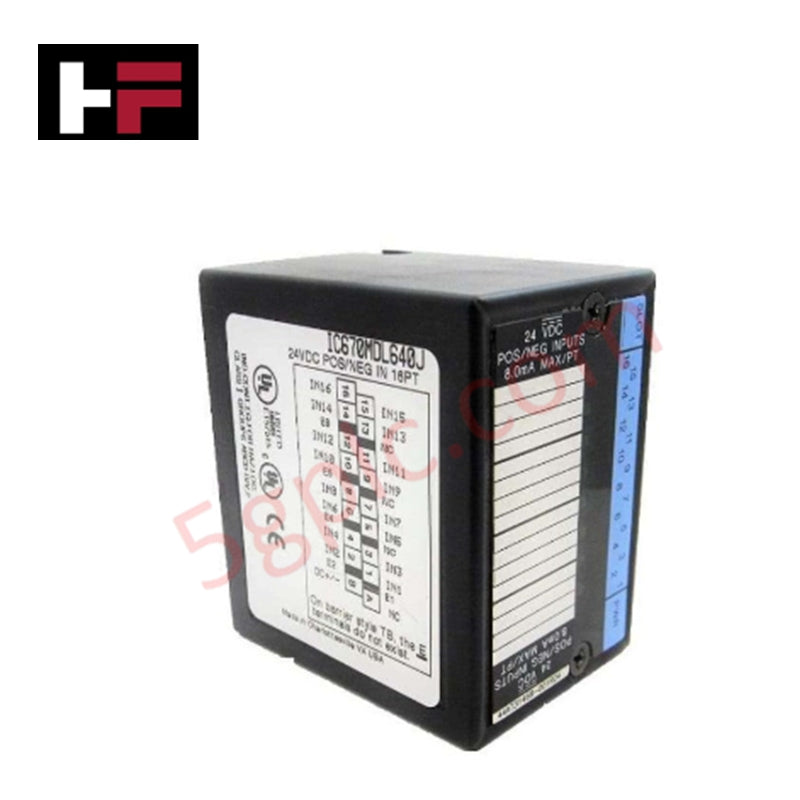
The GE Fanuc IC670MDL640 is a 16-point discrete input module engineered for the Field Control series. It provides reliable digital signal acquisition for 24 VDC systems and is optimized for industrial automation environments requiring robust and noise-immune input handling.
With its single-group input configuration and broad voltage tolerance, the module ensures consistent performance and fast signal response across a wide range of DC applications. Its durable isolation and high input impedance make it suitable for long cable runs and electrically demanding installations.
Technical Specifications
-
Manufacturer: GE Fanuc (Emerson)
-
Product Line: Field Control
-
Model Number: IC670MDL640
-
Product Type: 16-Point Discrete Input Module
-
Rated Voltage: 24 VDC nominal
-
Input Voltage Range: 0 to 30 VDC
-
Number of Channels: 16 isolated input points
-
Input Signal (Nominal): 24 VDC
-
Input Current: 7.5 mA per point at 24 VDC
-
Input Impedance: Approximately 3 kΩ
-
Isolation Voltage:
-
250 VAC continuous
-
1500 VAC for 1 minute (user input to logic and ground)
-
Current Draw from BIU Power Supply: 75 mA typical; 83 mA maximum
-
Logic Thresholds:
-
On-State Voltage: +15 to +30 VDC (positive logic) / –15 to –30 VDC (negative logic)
-
Off-State Voltage: 0 to +5 VDC (positive logic) / 0 to –5 VDC (negative logic)
-
On-State Current: 3.0 mA to 8.0 mA
-
Off-State Current: 0 to –5 VDC
-
Input Response Time: 6 ms typical; 10 ms maximum (On/Off transition)
-
Input Grouping: Single group of 16 points
-
Module Weight: 0.50 lbs (0.23 kg)
Key Features
-
Sixteen independent 24VDC discrete input points
-
Broad voltage tolerance for flexible system design
-
High input impedance reduces loading on field devices
-
1500 VAC isolation ensures safety and noise immunity
-
Compact and modular design compatible with GE Field Control racks
-
Fast signal transition times for responsive control performance
-
Built for long-term reliability in harsh industrial environments
Applications
-
Industrial machinery control systems
-
Factory automation and process monitoring
-
Material handling and packaging equipment
-
Power distribution and energy management systems
-
Building and transportation control applications
FAQ
Q1: What is the primary purpose of the IC670MDL640 module?
It detects digital (on/off) input signals from field devices such as switches, sensors, and relays, and transmits them to the control processor.
Q2: Can this module operate on negative logic systems?
Yes, it supports both positive and negative logic configurations, providing flexible integration options.
Q3: What type of isolation does the module provide?
The IC670MDL640 features 1500 VAC isolation between user input and logic or ground, ensuring electrical protection and reliability.
Q4: Is it compatible with other GE Field Control modules?
Yes, it is fully compatible with other GE Fanuc Field Control series modules and the Genius Bus Interface Unit.
Additional Information
- 100% Genuine Parts: All products are original and authentic, ensuring reliable industrial performance.
- 30-Day Refund Guarantee: Return any in-stock item within 30 days in original, unopened packaging for a full refund (excluding shipping and fees).
- 12-Month Warranty: Covers defects in materials or workmanship; excludes misuse, normal wear, or unauthorized modifications.
- Worldwide Shipping: We ship via USPS, UPS, FedEx, and DHL. Delivery times vary by country and may be subject to customs or import fees.
- Support & Contact: Technical and warranty assistance is available anytime. Contact us here: Contact.
- Purchase Guidance: Check product specifications and compatibility carefully before ordering to ensure proper application.
Tech & Buying Guide

Demystifying PLC Memory: A Technical Guide to Architecture, Retention, and Performance
Modern industrial automation relies heavily on the reliability of programmable logic controllers (PLCs). At the heart of every PLC lies its memory system. This subsystem directly dictates scan times, program capacity, and data survival during power outages. For field engineers, understanding how a control system allocates, retains, and secures this memory is essential for writing efficient code and preventing costly downtime.

Executing a PLC System Site Acceptance Test (SAT): The Definitive Engineering Guide
The transition of a Programmable Logic Controller (PLC) cabinet from a controlled factory floor to a volatile plant environment represents a critical milestone in factory automation. While a Factory Acceptance Test (FAT) validates standalone hardware compliance under ideal conditions, it cannot replicate real-world process dynamics. Therefore, deploying an industrial automation system requires a rigorous Site Acceptance Test (SAT) to verify total loop integrity, field wiring wiring metrics, and process control parameters before final customer handover.

Advanced Integration: Master Protocol for VFD Commissioning and Testing
Deploying variable frequency drives (VFDs) requires precise execution during the initial commissioning phase. Junior automation engineers often find the first power-up sequence intimidating. However, following a rigorous engineering framework ensures equipment safety and system reliability. Proper startup procedures protect both the drive electronics and the connected motor.