










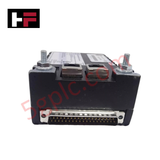
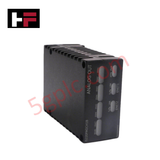
Product Details
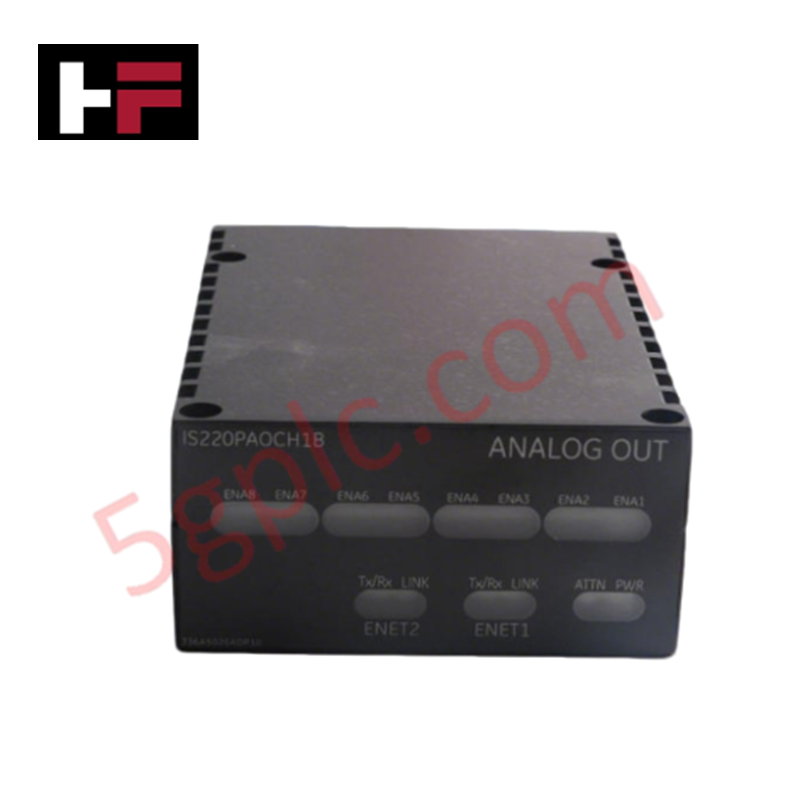
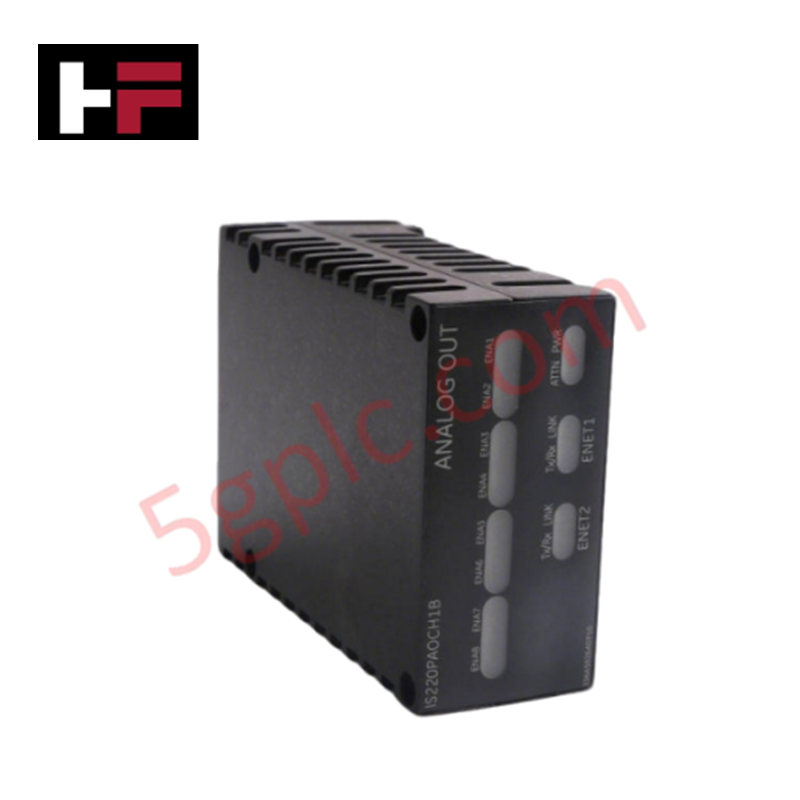
Configured for precision signal conversion and loop regulation in Mark VIe distributed control systems, the General Electric IS220PAOCH1B (IS220PAOCH1B Analog Output Module) provides direct physical/electrical execution of eight independent current-loop outputs.
Hardware Specifications
| Parameter | Specification |
|---|---|
| Model | IS220PAOCH1B |
| Brand | General Electric |
| Origin | USA |
| Dimensions | 8.26 cm H x 4.19 cm W x 12.1 cm D |
| Operating Temp | -30 deg C to 65 deg C |
| Channels | 8 current output channels |
| Output Range | 0-20 mA (up to 900 Ohms) |
| Accuracy | +/- 0.5% over -30 deg C to 65 deg C |
Profinet and Deterministic Network Operations
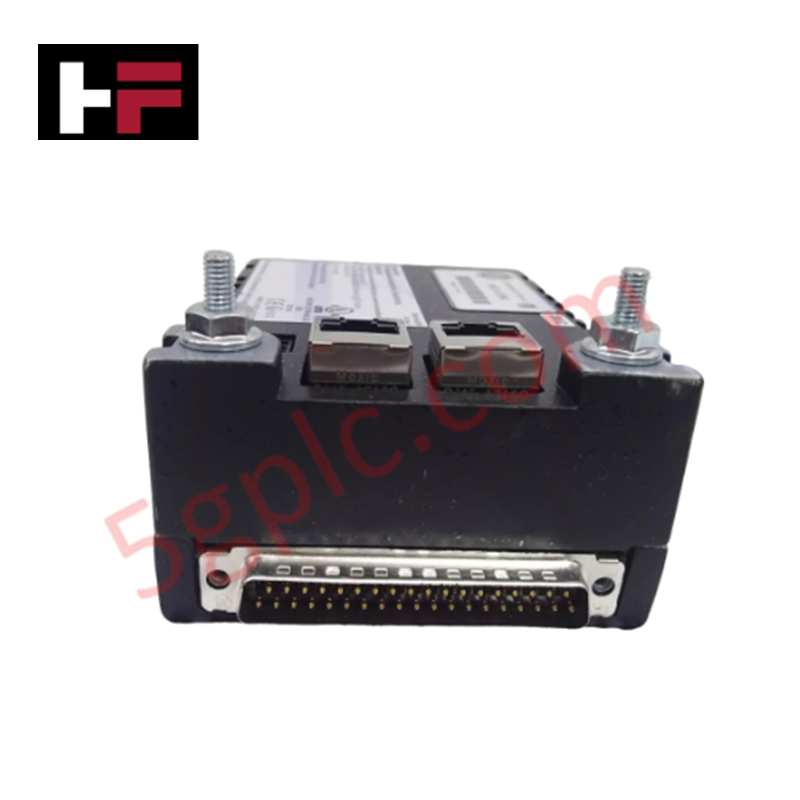
The IS220PAOCH1B utilizes dual RJ45 Ethernet connectors to facilitate deterministic communication within the Mark VIe I/O network. The module is architected with a common processor board shared across the Mark VIe line, paired with a dedicated analog output acquisition board to handle I/O density scaling. The firmware flash compatibility allows for seamless integration into existing control racks, supporting high-speed polling and diagnostic packet transmission. The module architecture ensures that all 0-20 mA output signals maintain loop integrity through internal current feedback monitoring, which is mapped back to the controller to verify execution against commanded setpoints.
Frequently Asked Questions (FAQ)
Q: Does the IS220PAOCH1B support hot-swapping in an energized Mark VIe rack?
A: Yes, the I/O pack is designed for removal and insertion while the system is powered, provided that the associated terminal board connection is handled to prevent unexpected output state changes.
Q: How is the current feedback verified for each channel?
A: Each of the eight output channels includes an internal analog-to-digital converter (ADC) that monitors the actual current loop feedback, providing high-fidelity loop health data to the host controller via the Ethernet interface.
Field Installation Guidelines
- Mechanical Coupling: The module uses a DC-37 pin connector for direct mating to the corresponding terminal board. Ensure the connector is fully seated and the retention hardware is secured to maintain mechanical stability and signal integrity.
- Network Connectivity: Utilize the dual RJ45 ports to establish redundant connections to the I/O Ethernet networks. Ensure that the cables are rated for industrial environments to minimize signal latency and packet loss.
- Power Termination: Use the specified three-pin connector for power input. Verify the supply voltage at the pin terminals before engaging the module to prevent damage to the internal power regulation circuitry.
- Diagnostic Verification: Upon installation, check the local diagnostic LED indicators. For advanced troubleshooting, utilize the infrared port to interface with local diagnostic tools if HMI-based status reporting is unavailable.
Additional Information
- 100% Genuine Parts: All products are original and authentic, ensuring reliable industrial performance.
- 30-Day Refund Guarantee: Return any in-stock item within 30 days in original, unopened packaging for a full refund (excluding shipping and fees).
- 12-Month Warranty: Covers defects in materials or workmanship; excludes misuse, normal wear, or unauthorized modifications.
- Worldwide Shipping: We ship via USPS, UPS, FedEx, and DHL. Delivery times vary by country and may be subject to customs or import fees.
- Support & Contact: Technical and warranty assistance is available anytime. Contact us here: Contact.
- Purchase Guidance: Check product specifications and compatibility carefully before ordering to ensure proper application.


Tech & Buying Guide

Comprehensive Guide to Noise Types in Industrial Automation and Electronics

Mitigating Emergency Stop Spurious Trips in Industrial Control Systems
Emergency stop (E-Stop) pushbuttons serve as vital safety devices in factory automation and process control plants. Functional safety standards mandate normally-closed (NC) contact blocks to ensure fail-safe operation during wiring breaks or power outages. However, mechanical degradation over time can trigger unexpected spurious trips, halting production lines without an actual emergency. Understanding the underlying causes of mechanical contact failure allows automation engineers to implement robust, fault-tolerant safety circuits.

Redundant Automation Systems: Maximizing Uptime in Critical Control Applications
Industrial automation relies on continuous operational stability to prevent catastrophic downtime and financial loss. While standard dictionary definitions treat redundancy as superfluous, industrial engineers consider redundant control architectures indispensable for high-availability systems. Implementing backup hardware ensures seamless takeover during primary equipment failures, protecting critical infrastructure across manufacturing and process industries.