












Product Details
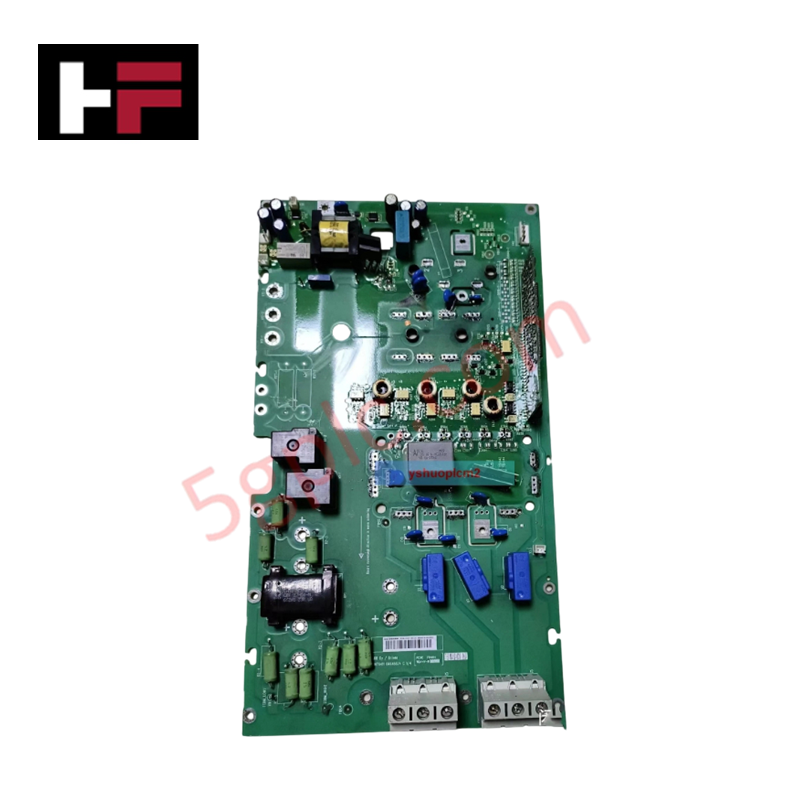
Configured for industrial automation and motor control in ACS800 series frequency converters, the ABB RINT-6411C (RINT-6411C Drive Control Board) provides direct physical/electrical execution.
Hardware Specifications
| Parameter | Specification |
|---|---|
| Model | RINT-6411C |
| Brand | ABB |
| Origin | Finland |
| Weight | 0.32 kg |
| Dimensions | 115 mm x 75 mm x 25 mm |
| Operating Temp | 0 to +50 deg C (Standard operational baseline) |
| Power Consumption | Internally derived from inverter bus supply |
| Product Type | Drive Control Boards |
| Application | Motor gate driver and interface circuit routing |
| Mounting | DIN rail |
Profinet / EtherNet/IP Deterministic Networks and Driver Synchronization
The electrical layout of the RINT-6411C routes internal gating commands directly to the main inverter power semiconductors while maintaining real-time parity with the host processor board. This data path manages gate switching states synchronously with master parameters, protecting backplane bus communication velocity and preventing instruction drift when integrated with Profinet / EtherNet/IP deterministic networks. The layout preserves strict firmware flash compatibility across standard ACS800 control units, ensuring localized pulse-width modulation processing does not alter host timing constraints or decrease external I/O density scaling options.
Frequently Asked Questions
Q: Does the RINT-6411C support direct hot-swap physical replacement while the main DC bus is charged?
A: No. The board operates in direct electrical connection with high-voltage inverter circuits. The entire drive unit must be powered down, and the DC bus capacitors must be fully discharged before executing maintenance or physical board extraction.
Q: How is configuration data or firmware flash compatibility verified for this replacement unit?
A: The RINT-6411C functions primarily as an interface and gating distribution layer. It synchronizes with the main drive application program automatically upon power-up, provided that hardware jumper profiles on the board match the factory specifications of the host frame size.
Q: What mechanisms protect the communication path from high-frequency electromagnetic noise?
A: The internal logic layout implements differential signal pathways and dedicated filtering capacitors to isolate logic processing matrices from the high dv/dt switching transients generated by adjacent IGBT modules.
Field Installation Guidelines
- DIN Rail Alignment: Mount the board securely to the internal cabinet 35 mm DIN rail. Ensure the structural locking clips engage fully to suppress physical displacement from motor-induced mechanical vibration.
- Ribbon Cable Seating: Connect the parallel multi-pin ribbon cables to the primary processor assembly. Verify that all locking tabs click into place to prevent intermittent data drops during thermal expansion cycles.
- Low-Impedance Bonding: Ensure the DIN rail mounting pathway links directly to the common structural inverter ground plate. A clean metal-to-metal contact is required to sink common-mode noise away from the gate driver channels.
- Clearance and Airflow: Maintain the specified 25 mm depth profile clearance boundaries free from obstruction to enable unimpeded convective airflow from the main chassis cooling fans.
Additional Information
- 100% Genuine Parts: All products are original and authentic, ensuring reliable industrial performance.
- 30-Day Refund Guarantee: Return any in-stock item within 30 days in original, unopened packaging for a full refund (excluding shipping and fees).
- 12-Month Warranty: Covers defects in materials or workmanship; excludes misuse, normal wear, or unauthorized modifications.
- Worldwide Shipping: We ship via USPS, UPS, FedEx, and DHL. Delivery times vary by country and may be subject to customs or import fees.
- Support & Contact: Technical and warranty assistance is available anytime. Contact us here: Contact.
- Purchase Guidance: Check product specifications and compatibility carefully before ordering to ensure proper application.






Tech & Buying Guide

Demystifying CPU Communication Ports in Siemens PLC Architectures
Industrial automation relies heavily on robust data exchange between devices. Without seamless connectivity, field instruments, network switches, human-machine interfaces, and programmable logic controllers cannot coordinate effectively. Therefore, understanding the various CPU communication ports available in Siemens hardware ensures efficient factory automation design and seamless system integration.

Mastering the Siemens PLC Scan Cycle: How the CPU Executes Automation Programs
Industrial automation relies heavily on programmable logic controllers (PLCs) to manage complex manufacturing processes. Many engineers dive straight into programming without mastering the underlying architecture. However, understanding how a PLC CPU executes a program ensures reliable system design. Therefore, mastering the scan cycle optimizes both performance and troubleshooting in modern control systems.

How to Connect to Siemens S7 PLCs: 5 Essential Communication Methods
Establishing a reliable hardware link between a programming terminal and a Siemens SIMATIC controller is essential for engineering workflows. Field engineers rely on distinct physical layers, ranging from legacy serial connections to high-speed Industrial Ethernet protocols. Modern factory automation environments prioritize fast data transfer and seamless driver integration. Selecting the correct connection method simplifies program downloads, online monitoring, and system troubleshooting in complex control systems.